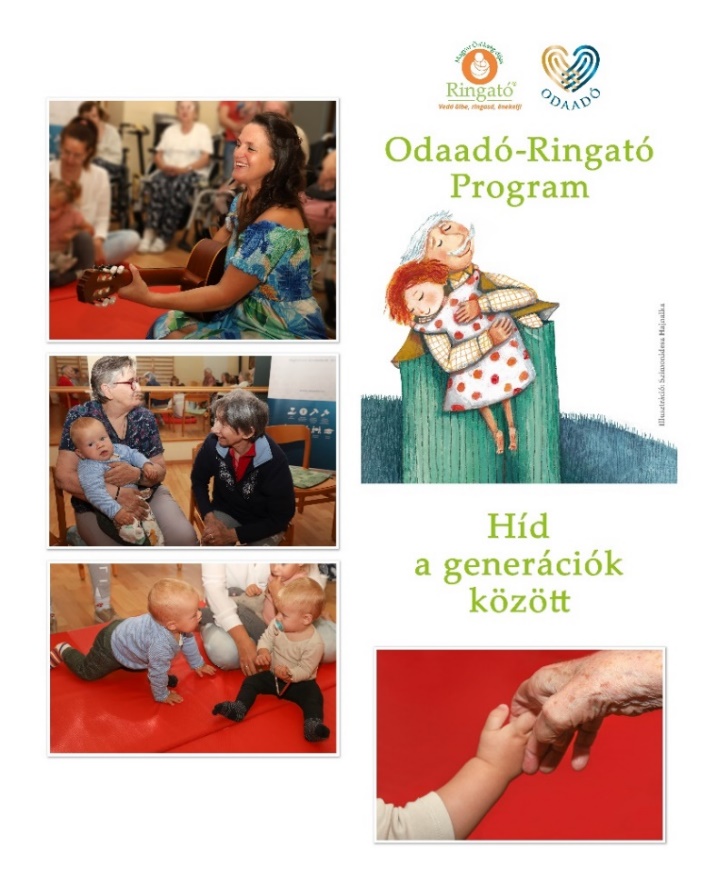
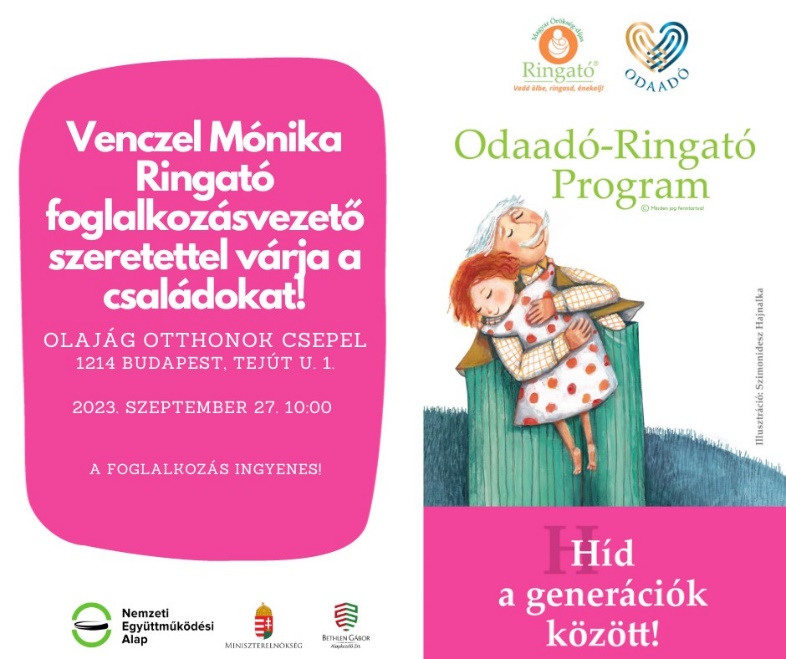
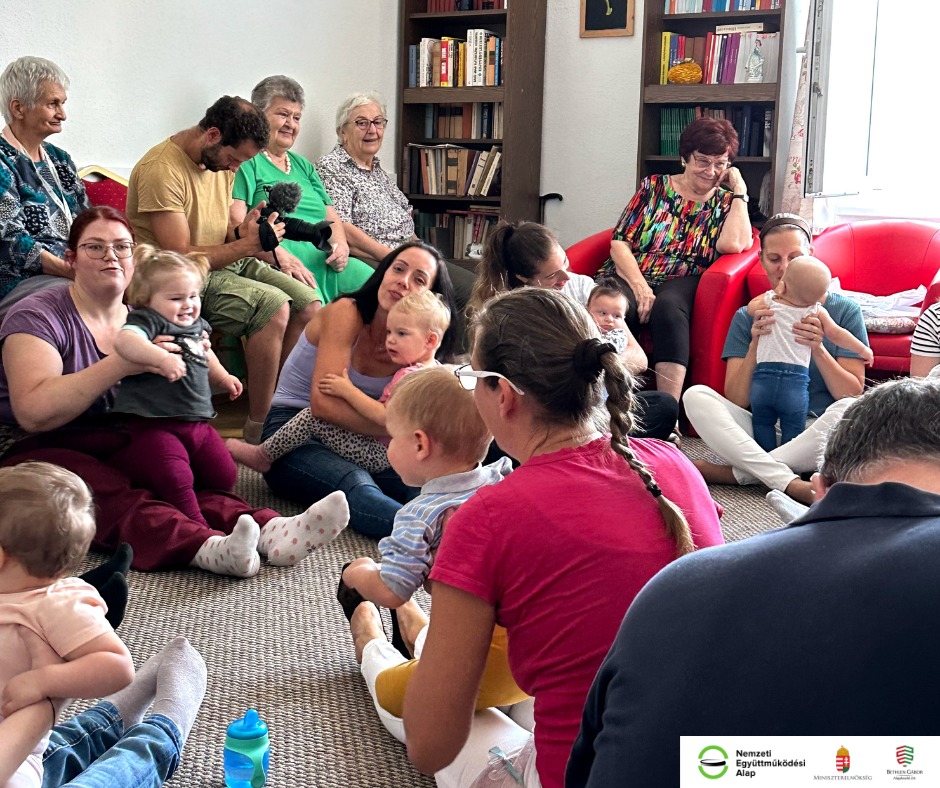
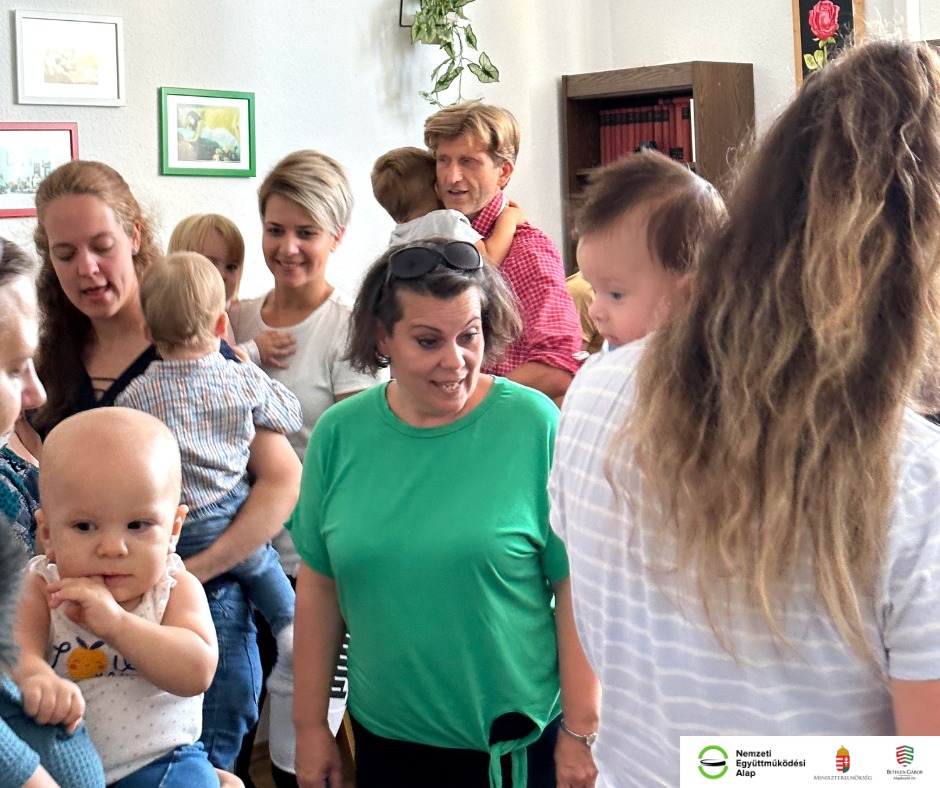
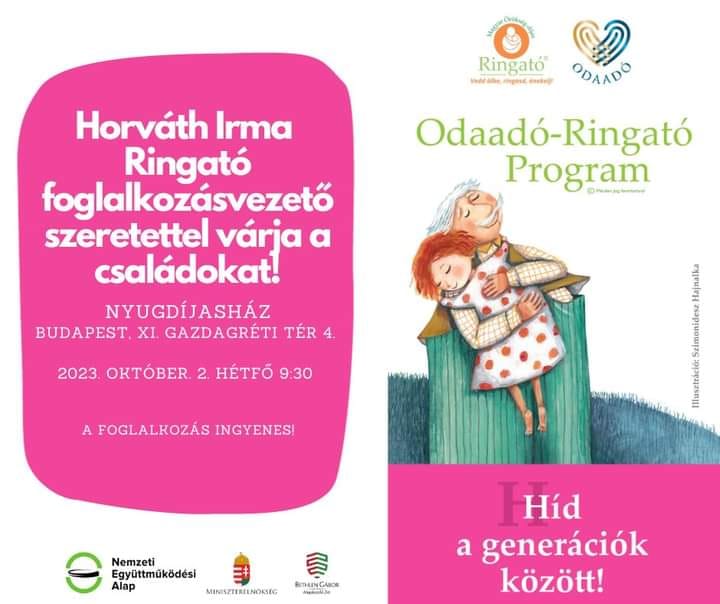
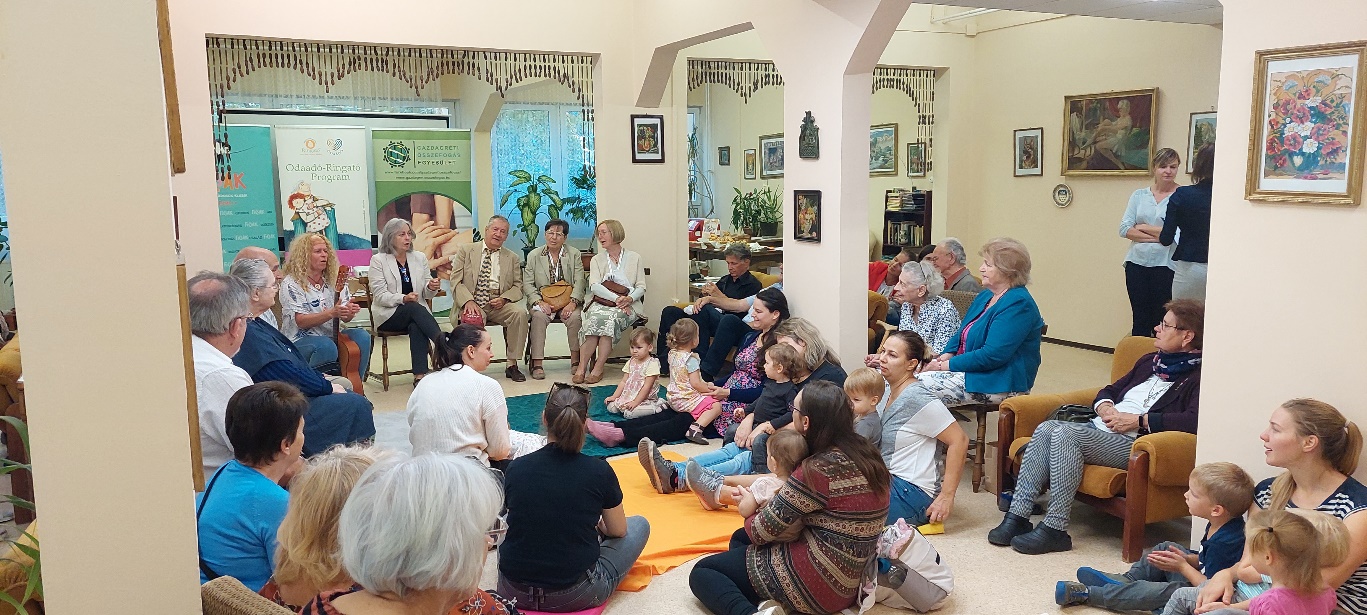
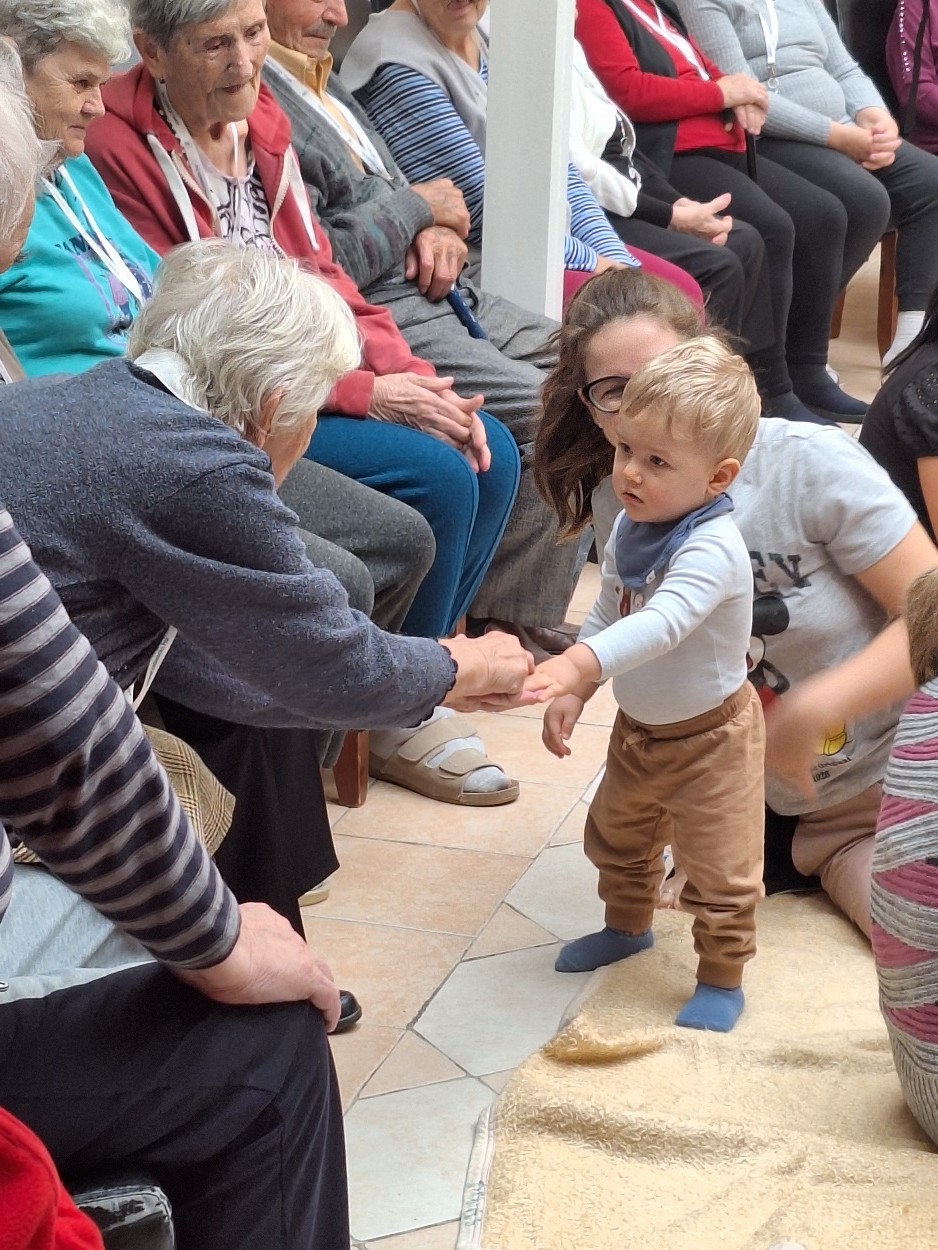
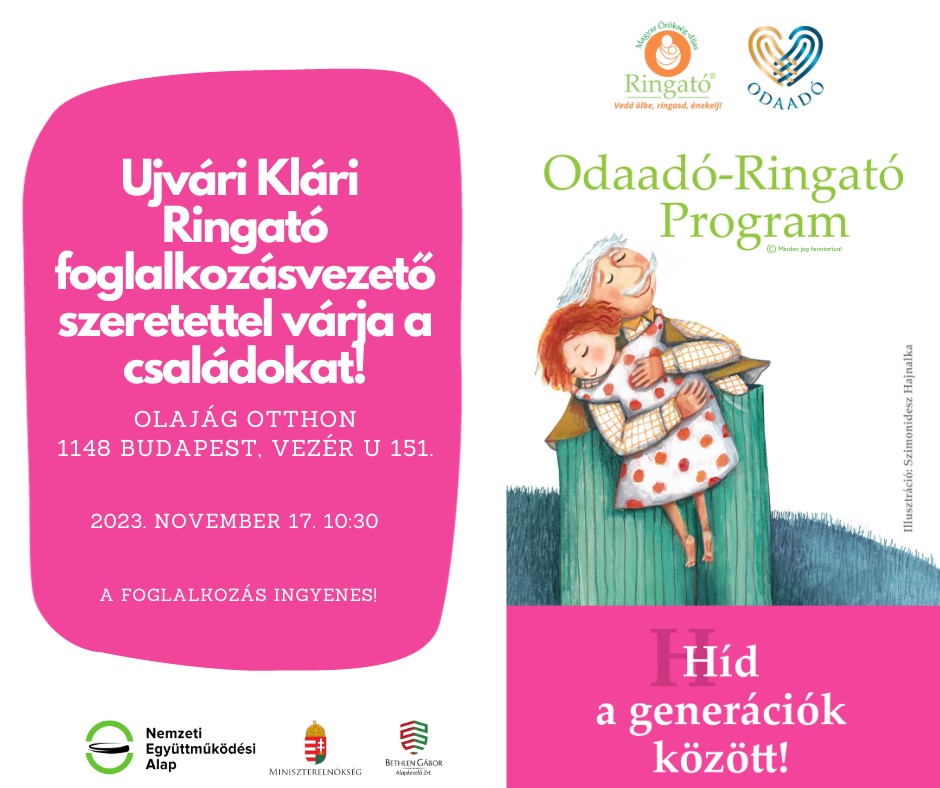
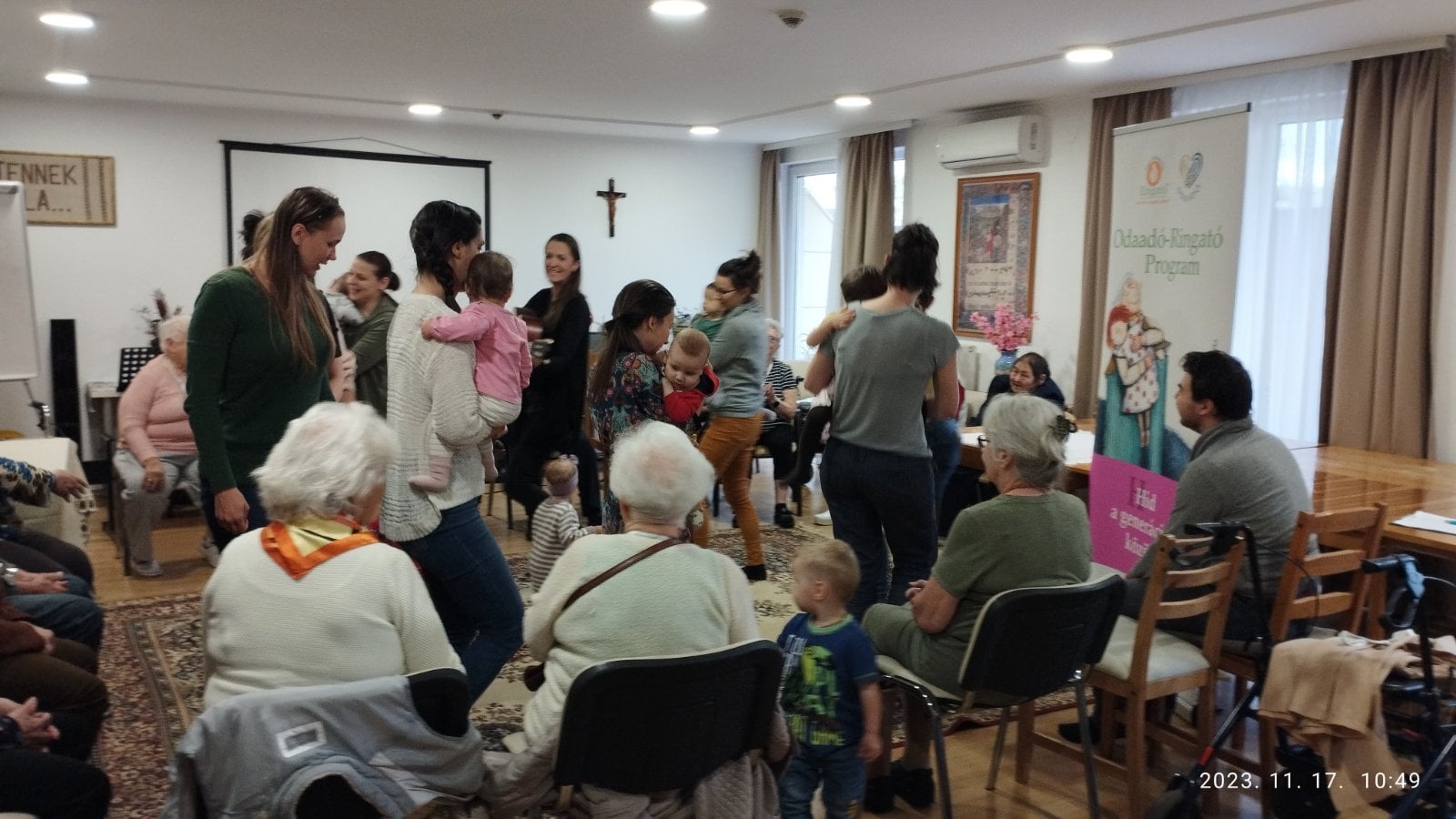
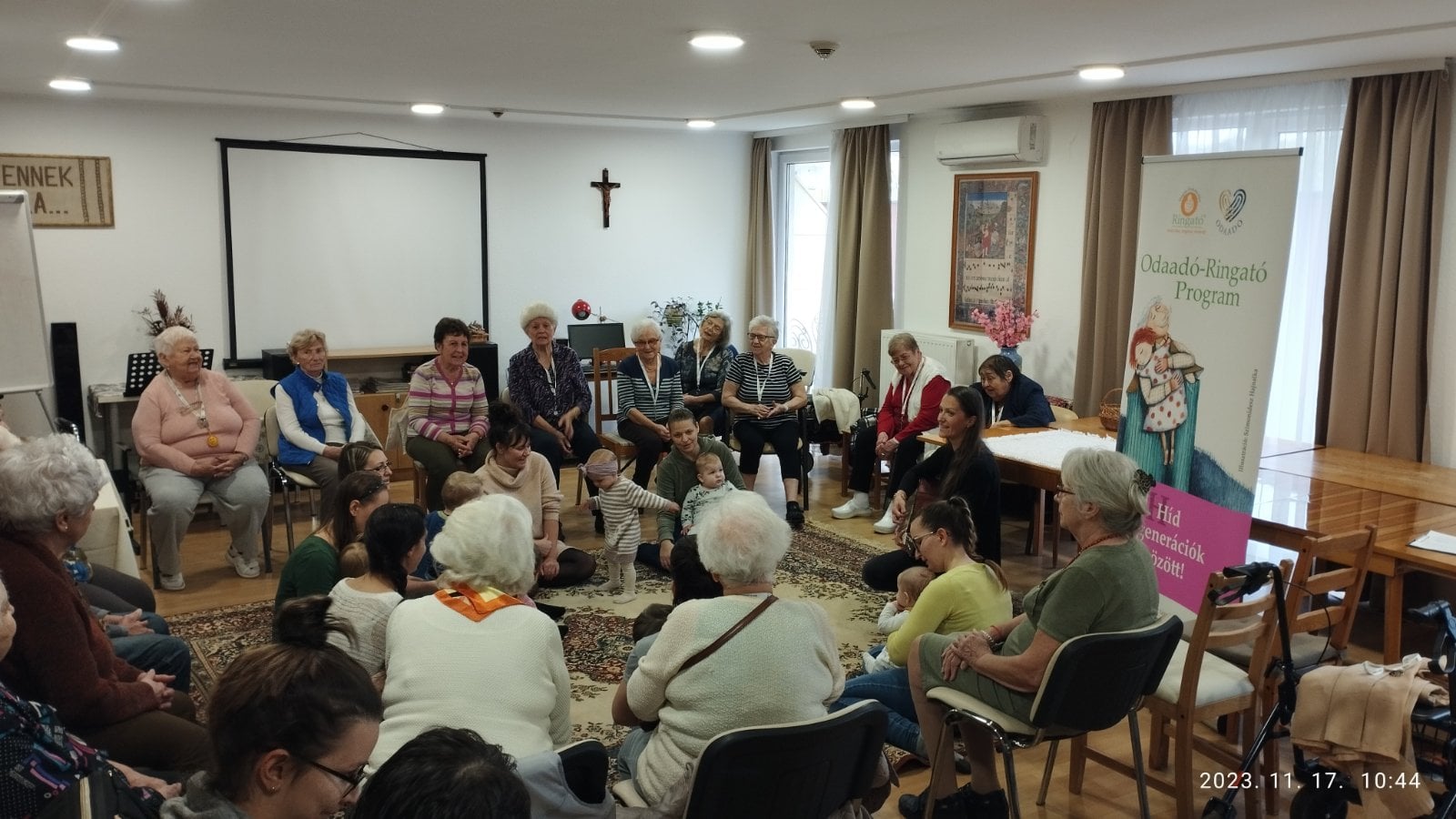
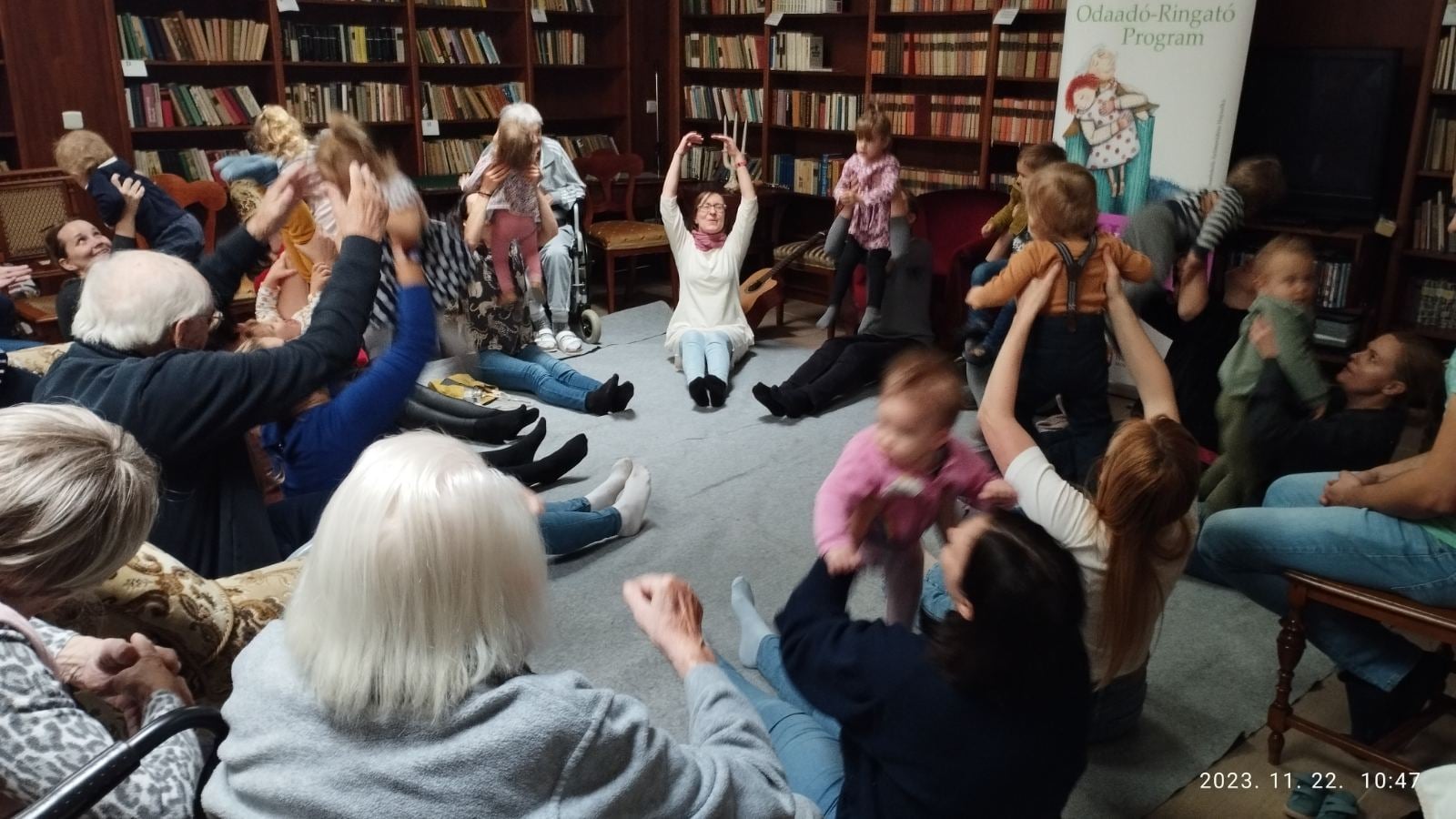
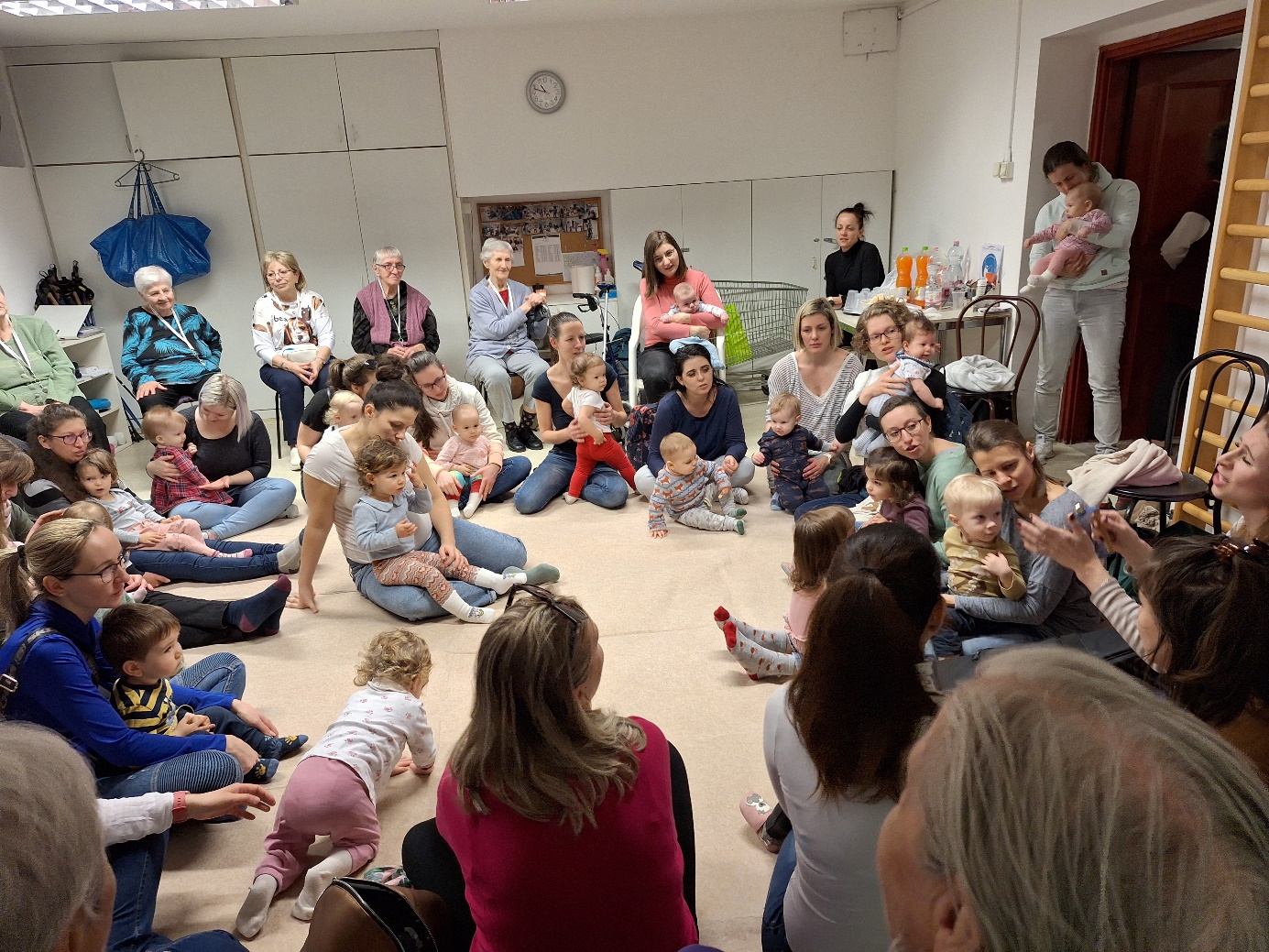
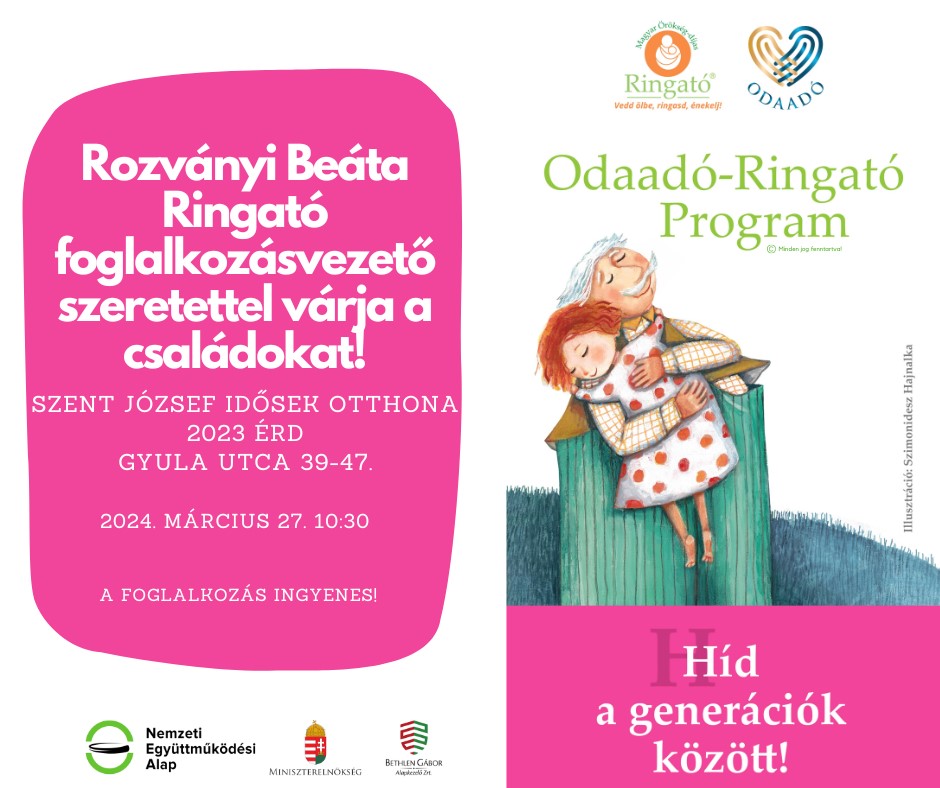
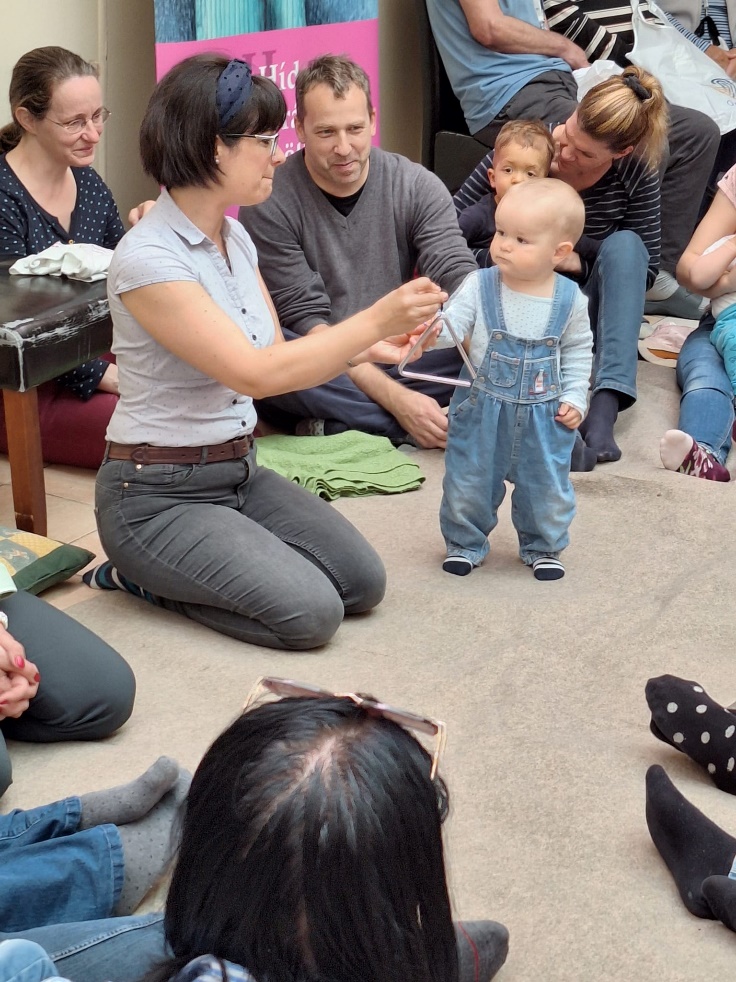
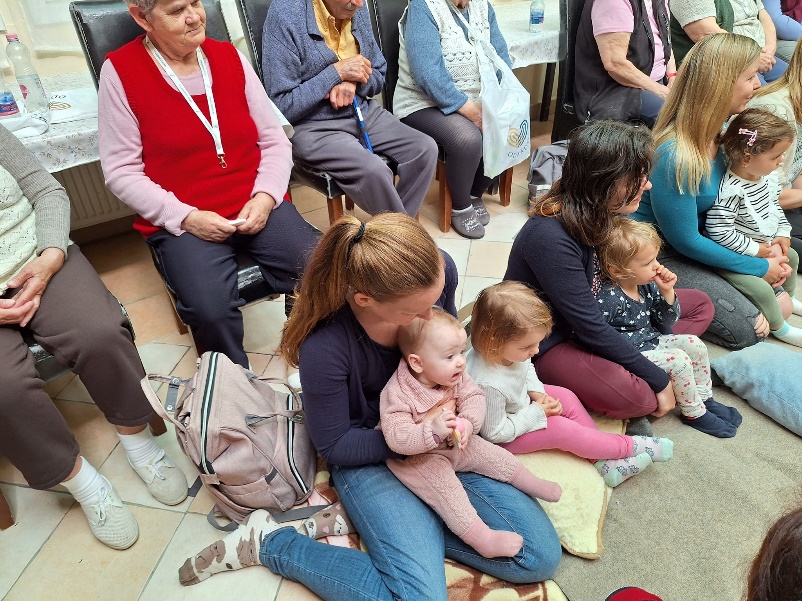
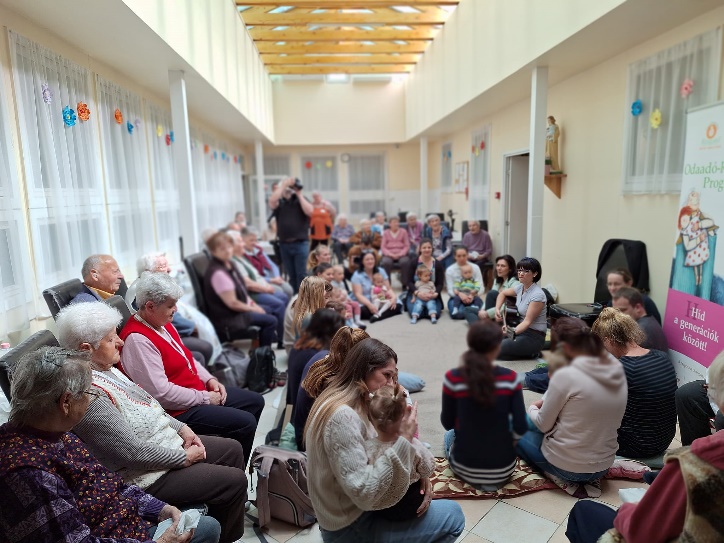
Odaadó-Ringató Programme sessions. This programme consists of Ringató sessions held in residential homes for older people, where Ringató session leaders take part together with enthusiastic mothers, fathers and children among the residents of the homes. These occasions create connections between generations and provide a special experience. Many of the older participants live with dementia and may no longer be able to speak, yet singing can still enable us to connect with them. Older people and mothers with young children take part in the shared singing and play together. The presence of the children brings great joy to everyone. The other pillar of the programme is provided by Civilút, the organisation behind the Odaadó Programme, whose participants contribute literary readings to these occasions.
We held a total of 11 sessions at the following locations:
Veszprém, Életöröm Otthon: 2023. 09. 05.
Csepeli Olajág Otthonok: 2023. 09. 27.
Gazdagrét, Nyugdíjas Ház: 2023. 10. 02.
Solt: 2023. 11. 03.
Törökbálint: 2023. 11. 06.
Érd, Gyula utca, Szent József Idősek Otthona: 2023. 11. 15.
Zugló: 2023. 11. 17.
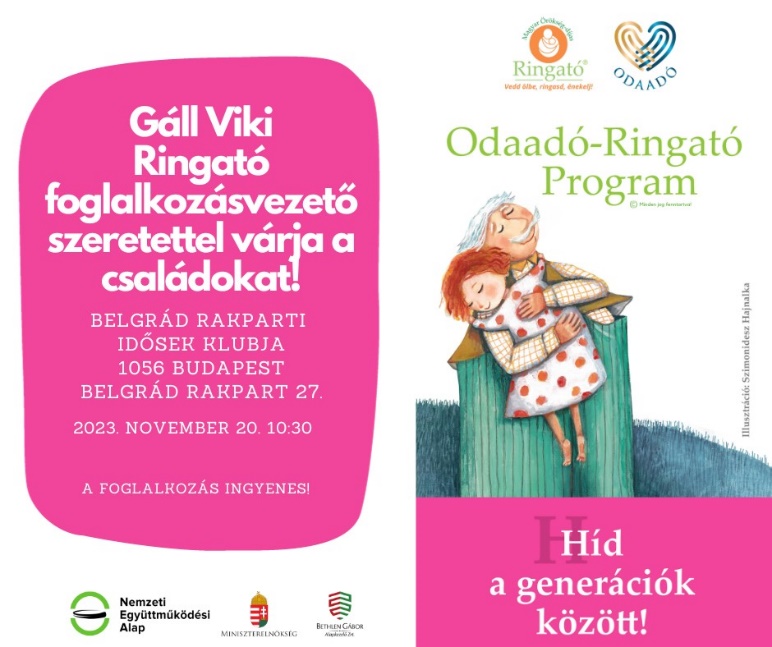
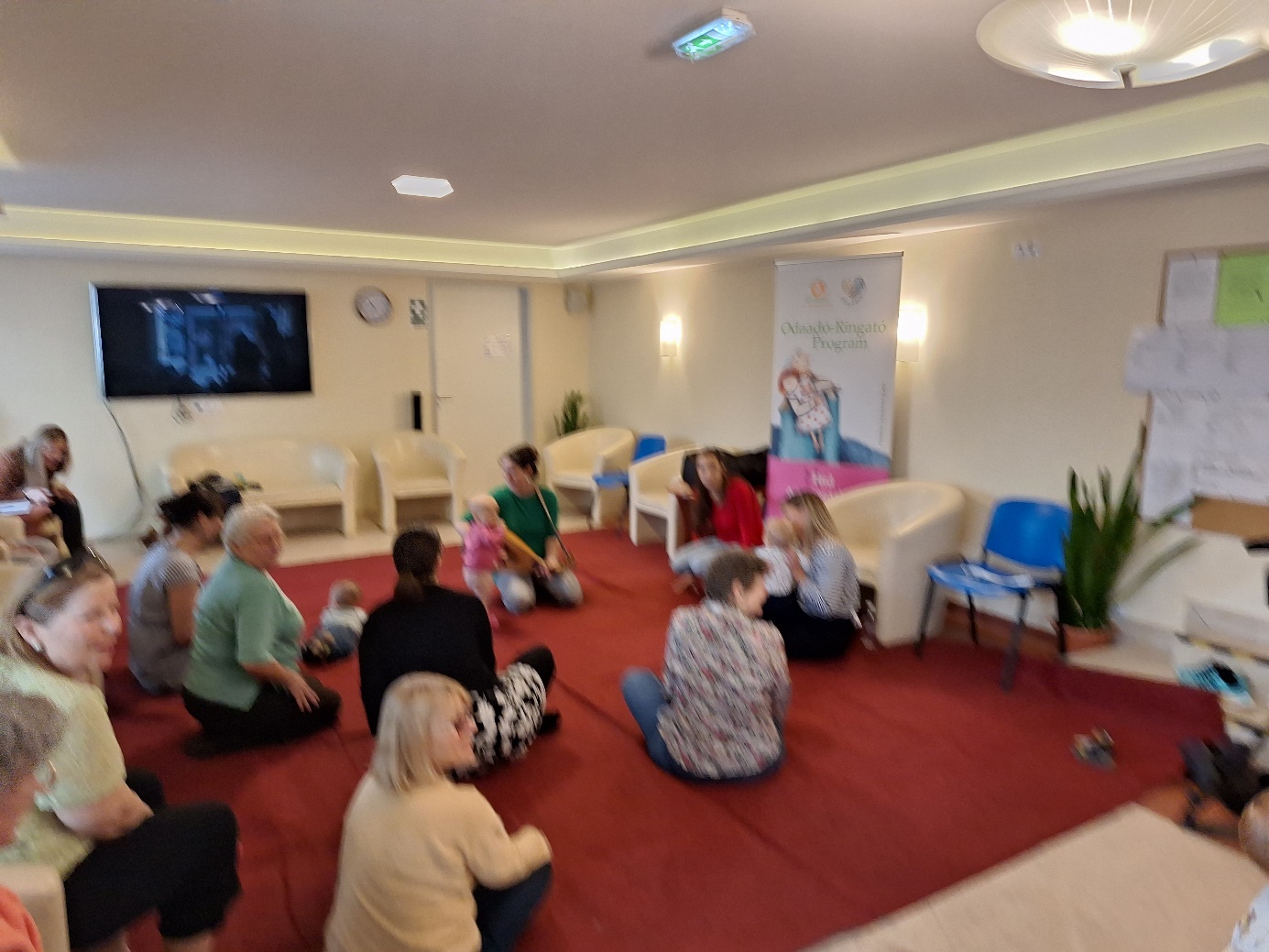
Budapest V. ker., Belgrád rkp. – Idősek Klubja: 2023. 11. 20.
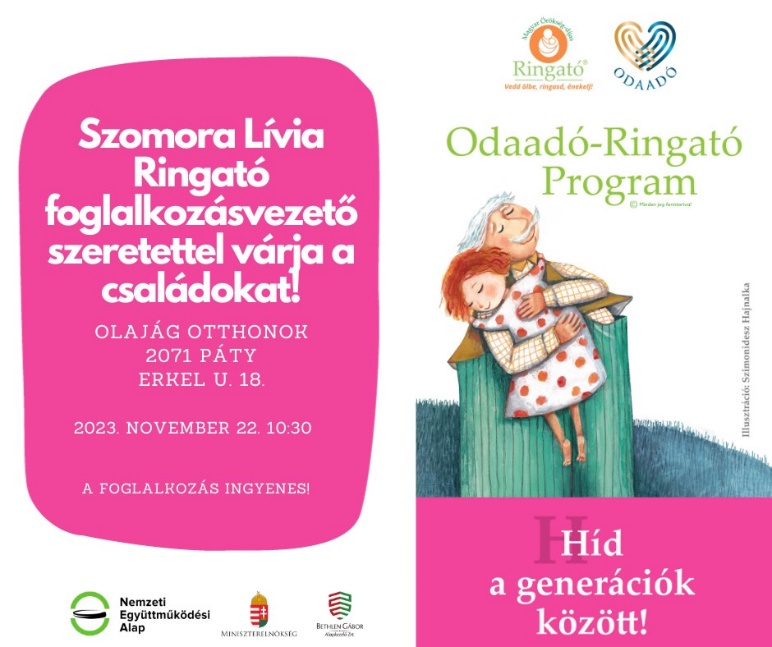
Páty: 2023. 11. 22.
Újpalota: 2024. 02. 16.
Érd: 2024. 03. 27.
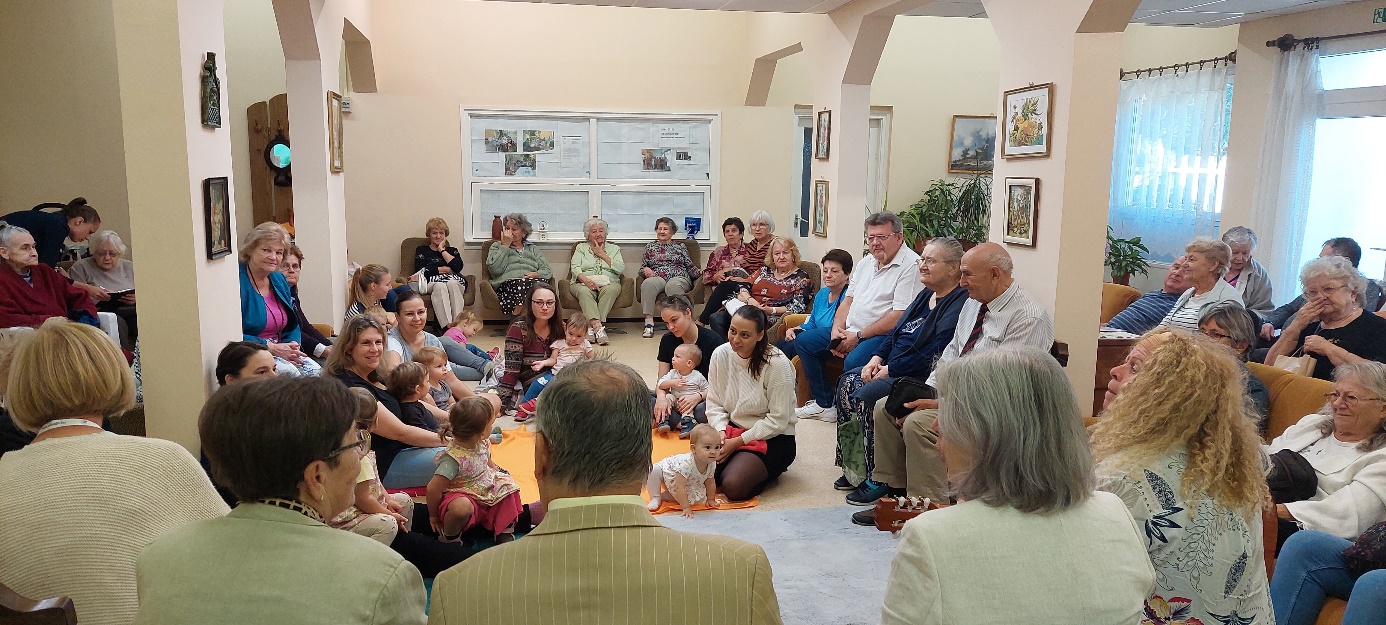
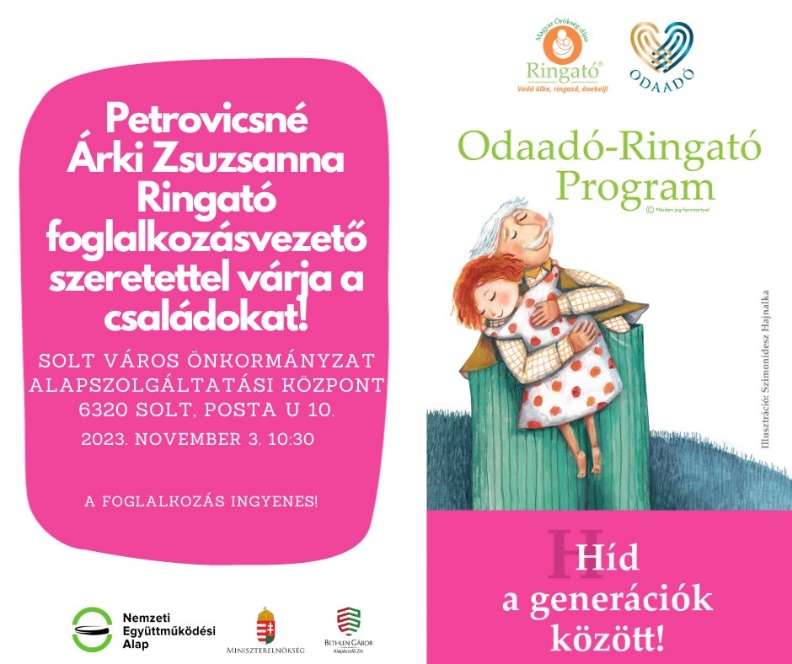
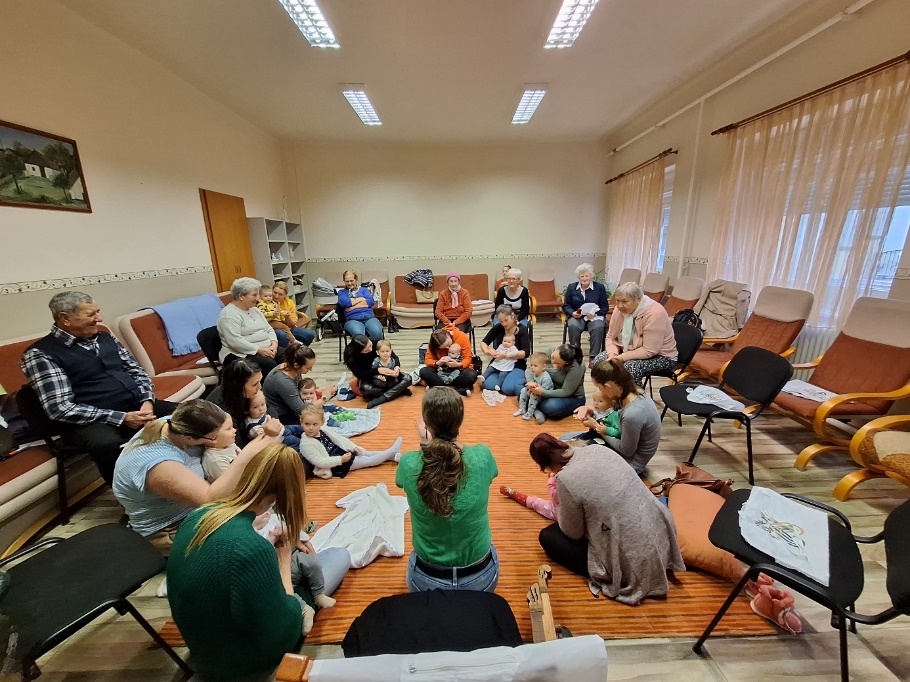
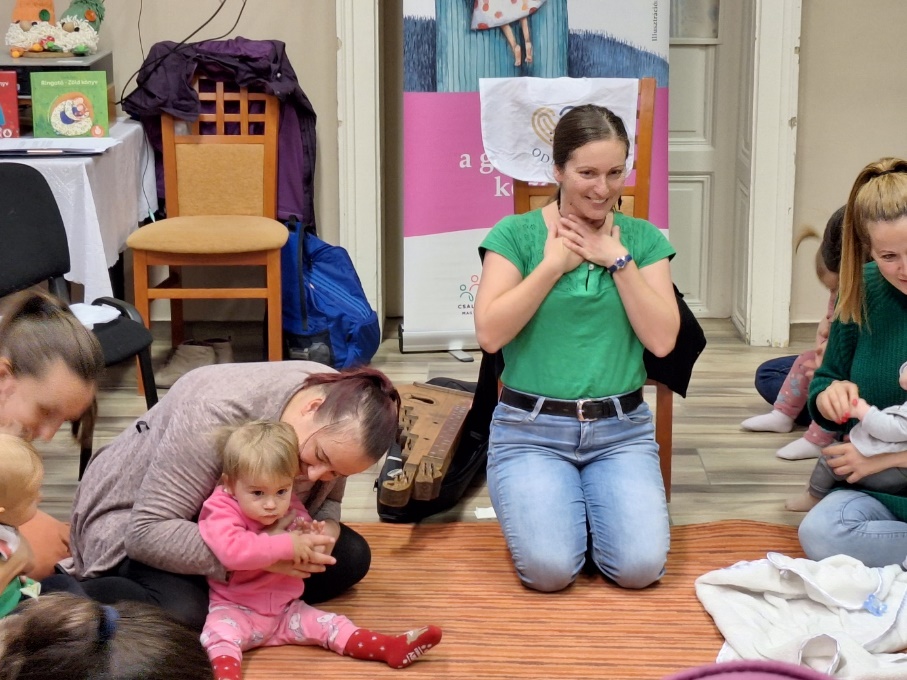
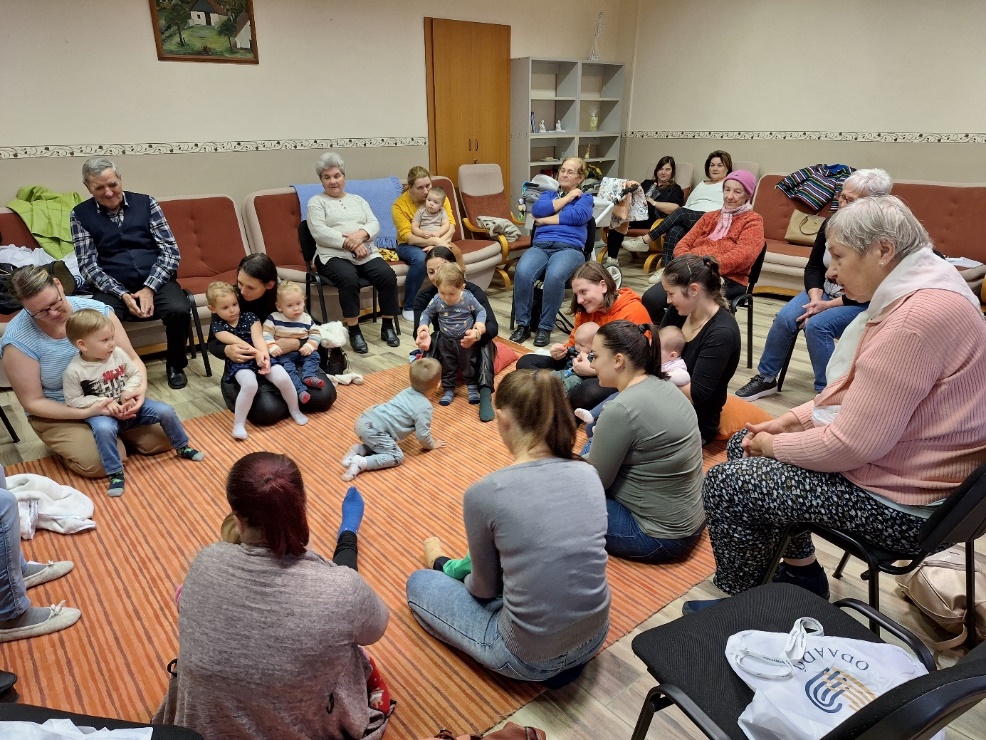
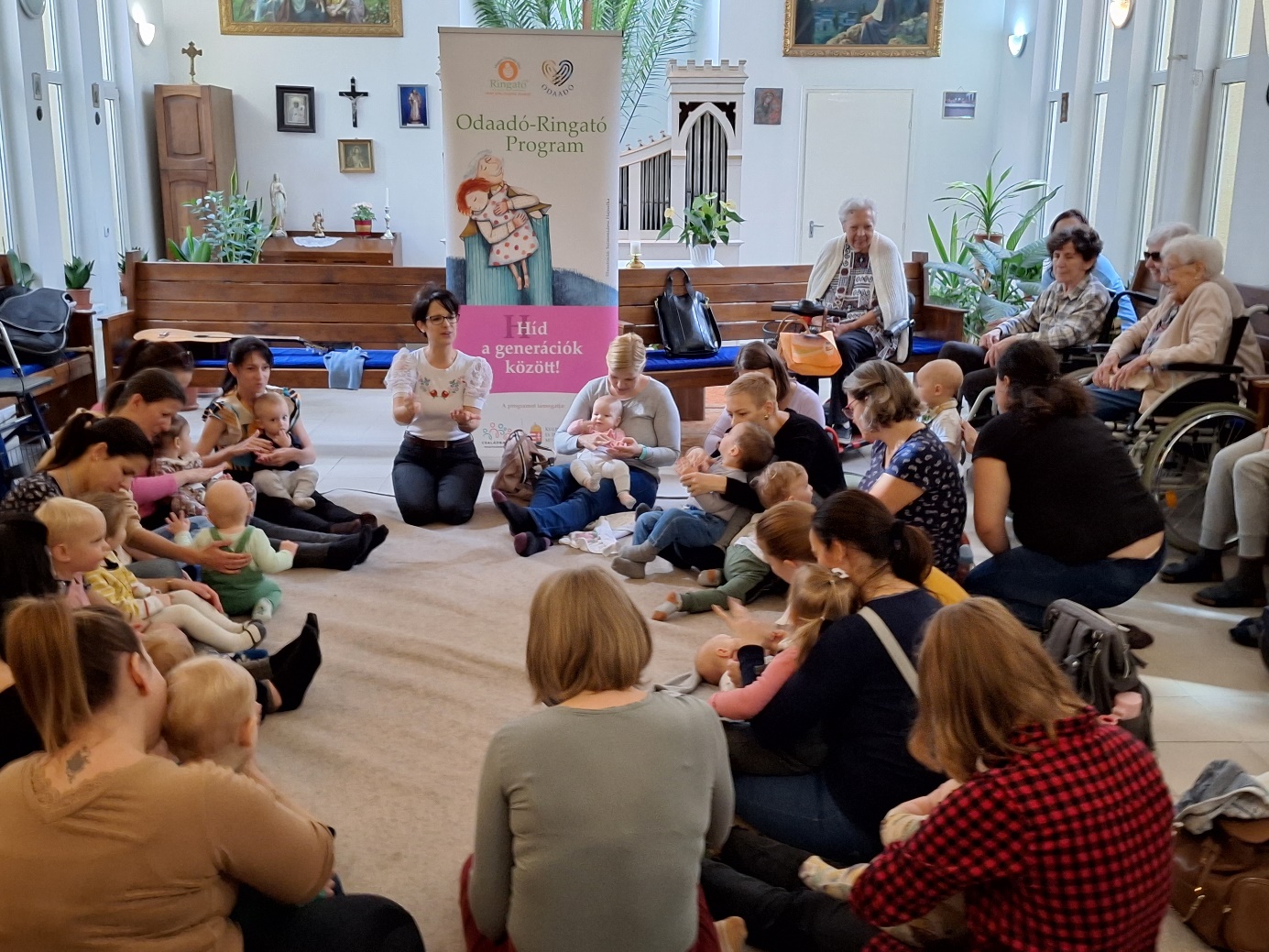
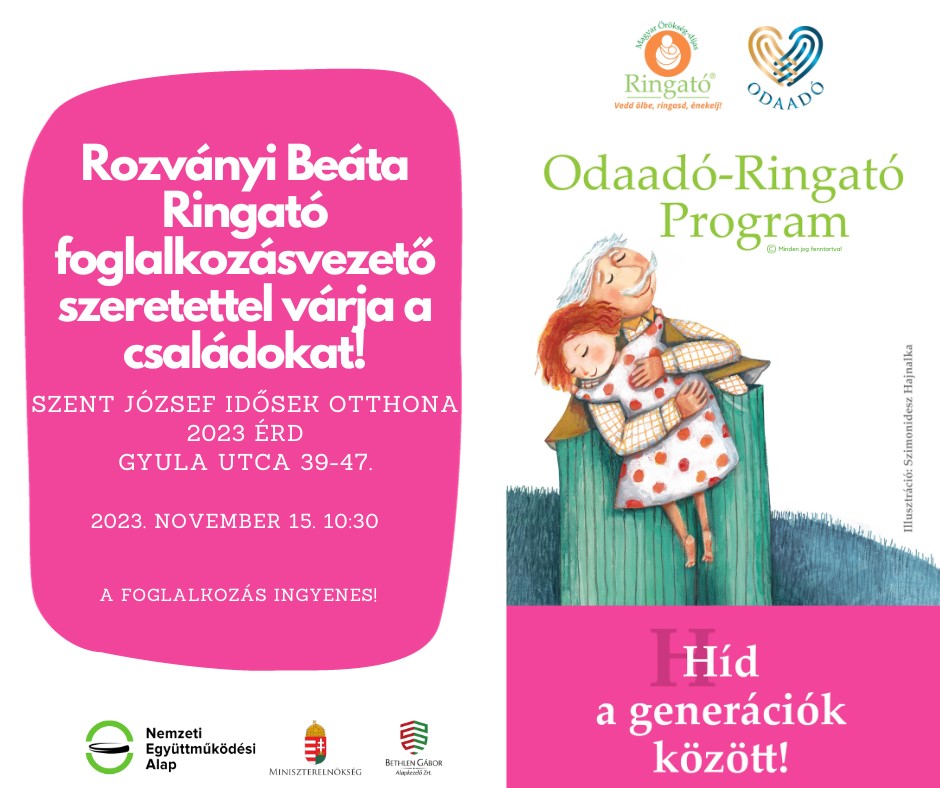
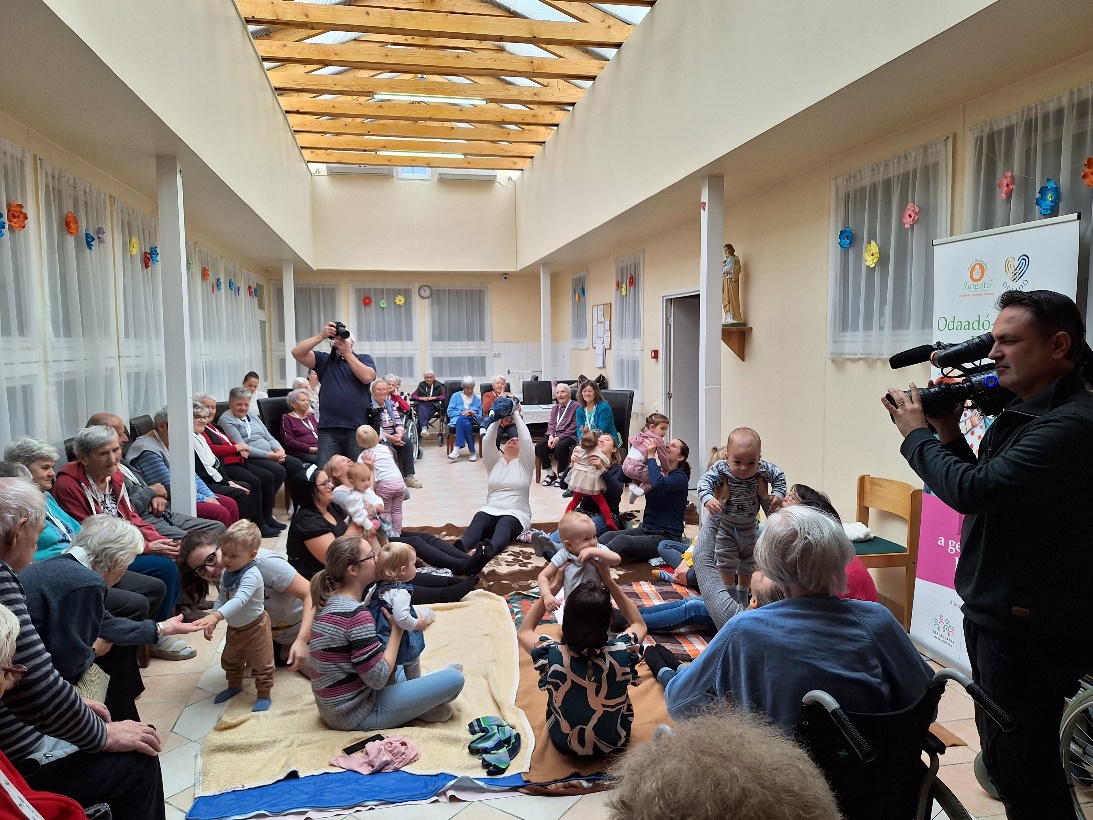


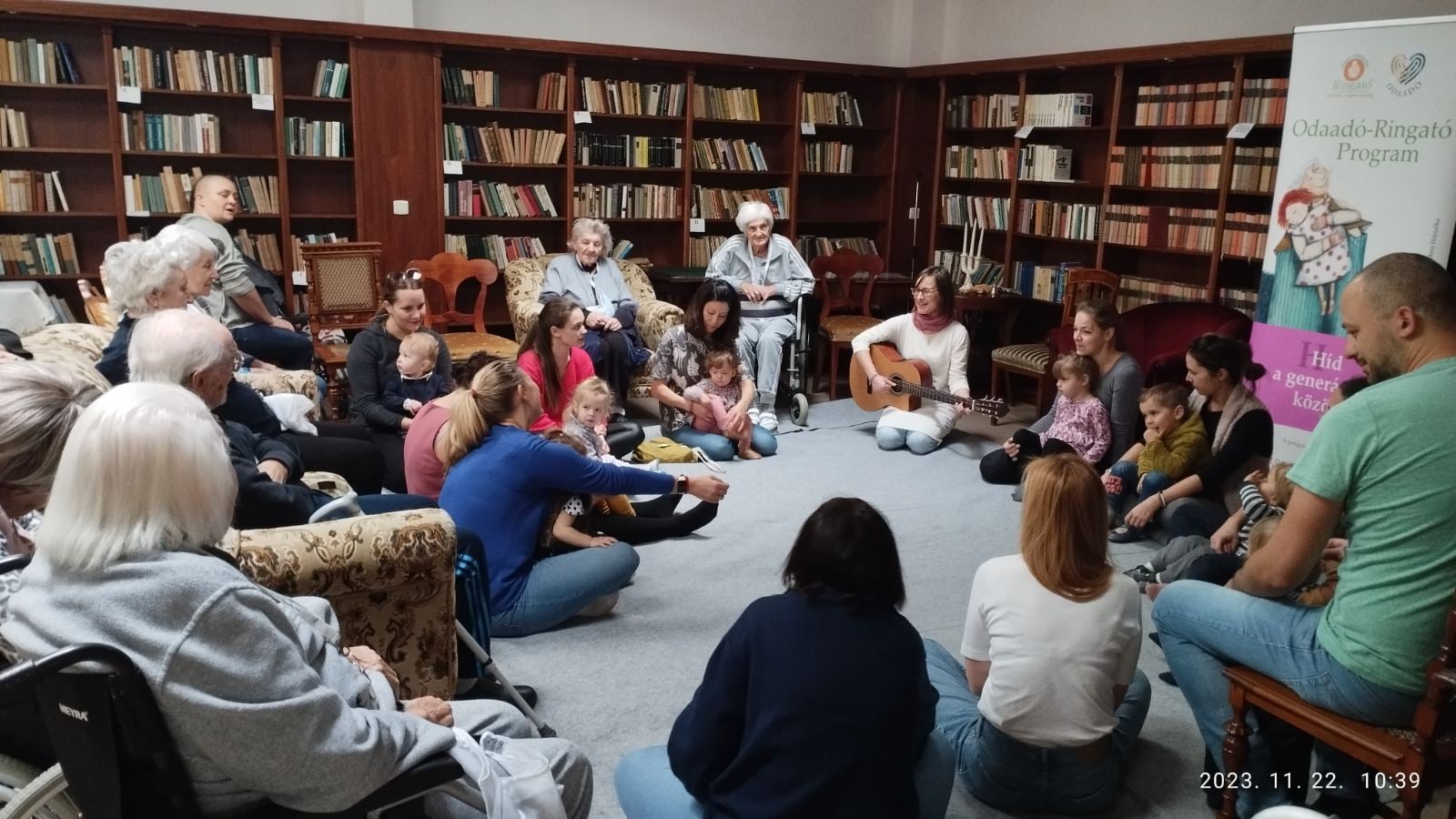
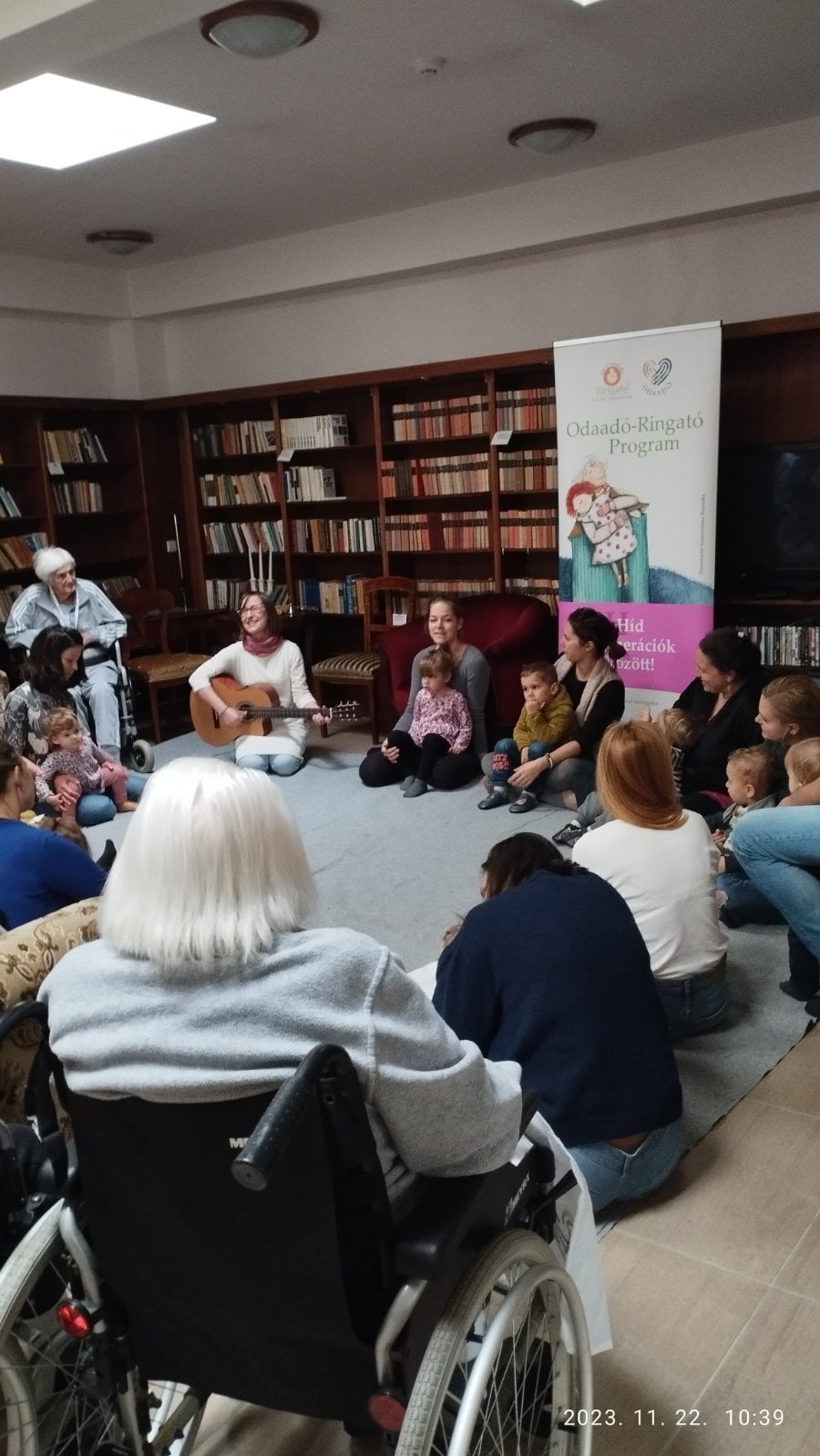
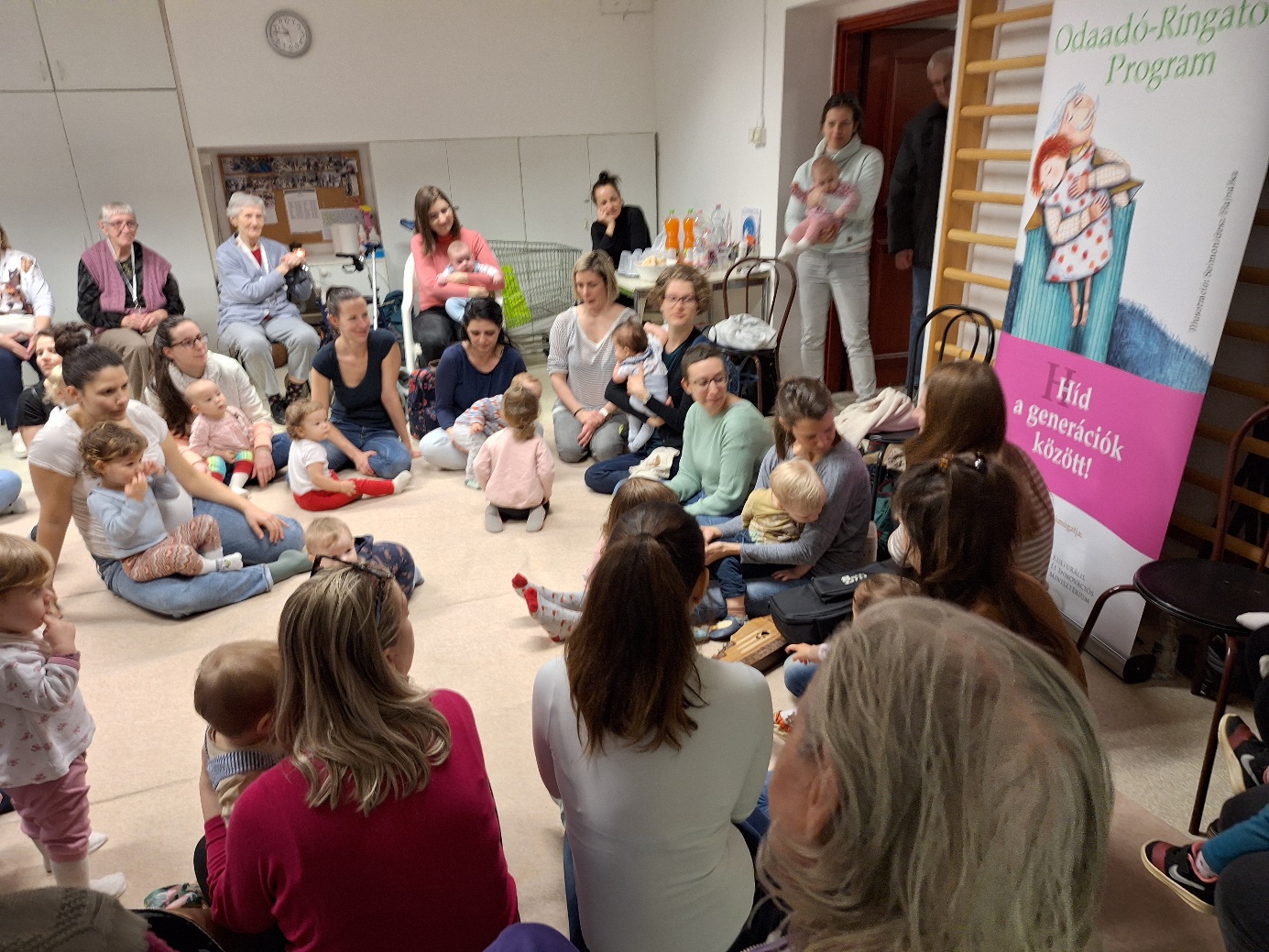
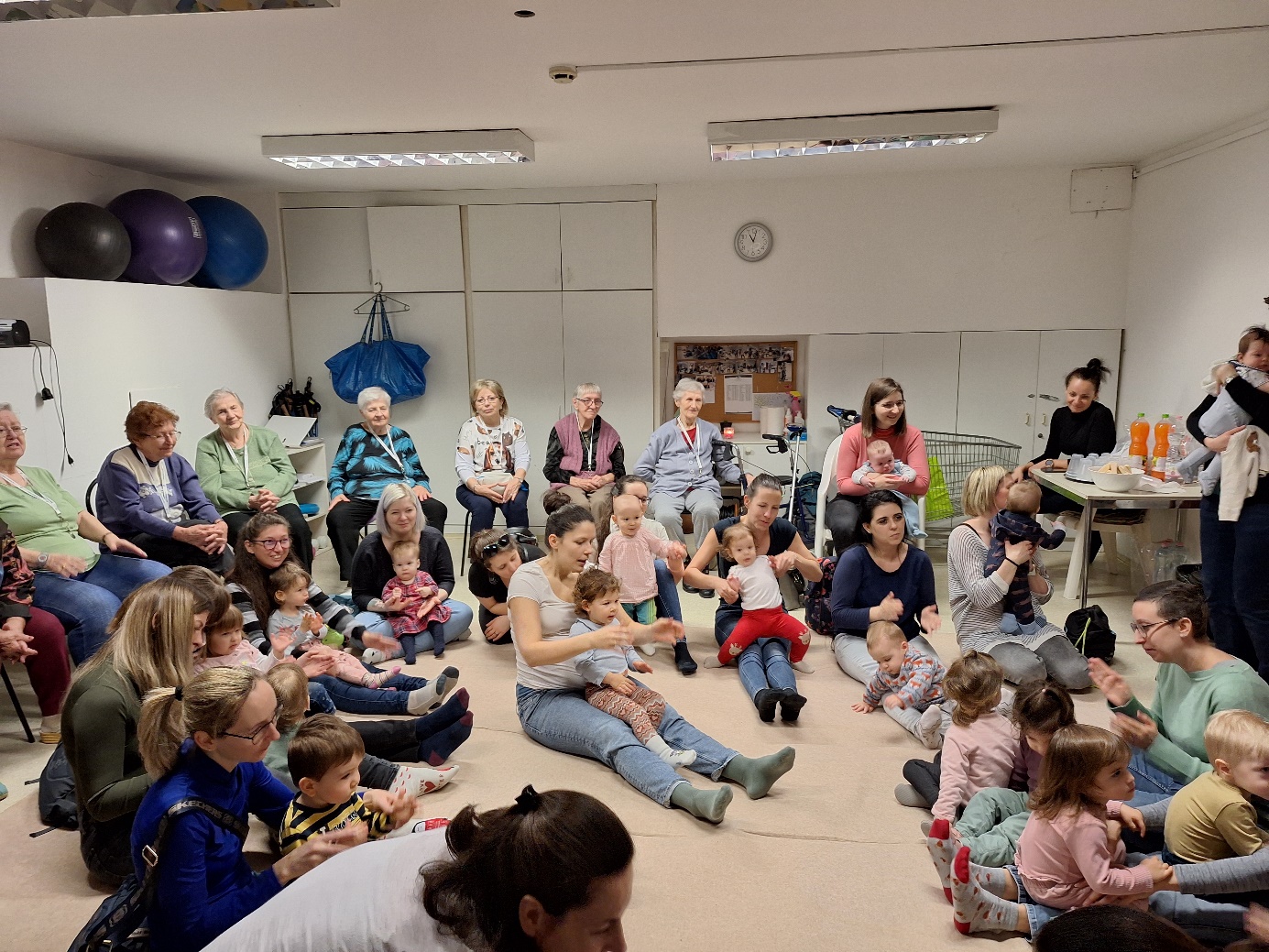

With funding from project CNP-KP-1-2021/1-000221, the Ringató Foundation carried out the following professional activities:
1. Writing and publishing the Ringató methodology handbook in summer 2022:
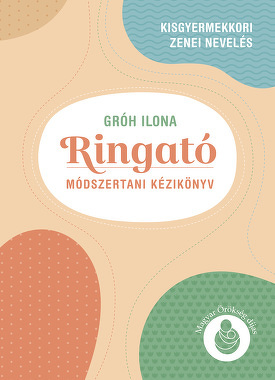
This music-education handbook presents a special form of session leadership (arts education), refined over decades and based on Kodály principles. We recommend it to educators and to anyone interested in early childhood music education. The Ringató method and the author of the book received the Hungarian Heritage Award in autumn 2021. "…what music educator Ilona Gróh has created with the Ringató music education programme since 1991, over the past 30 years, can without exaggeration be called a miracle. In our modern world, defying the forces that pull us down, she restored to mothers and fathers that seemingly forgotten knowledge and skill which used to be natural in traditional rural life. Thanks to the Ringató programme, hundreds of thousands, perhaps millions, of parents in Hungary and abroad are singing to and with their children again. Ilona Gróh created the background for this: she not only developed the method, but also taught young, talented educators how to apply it."
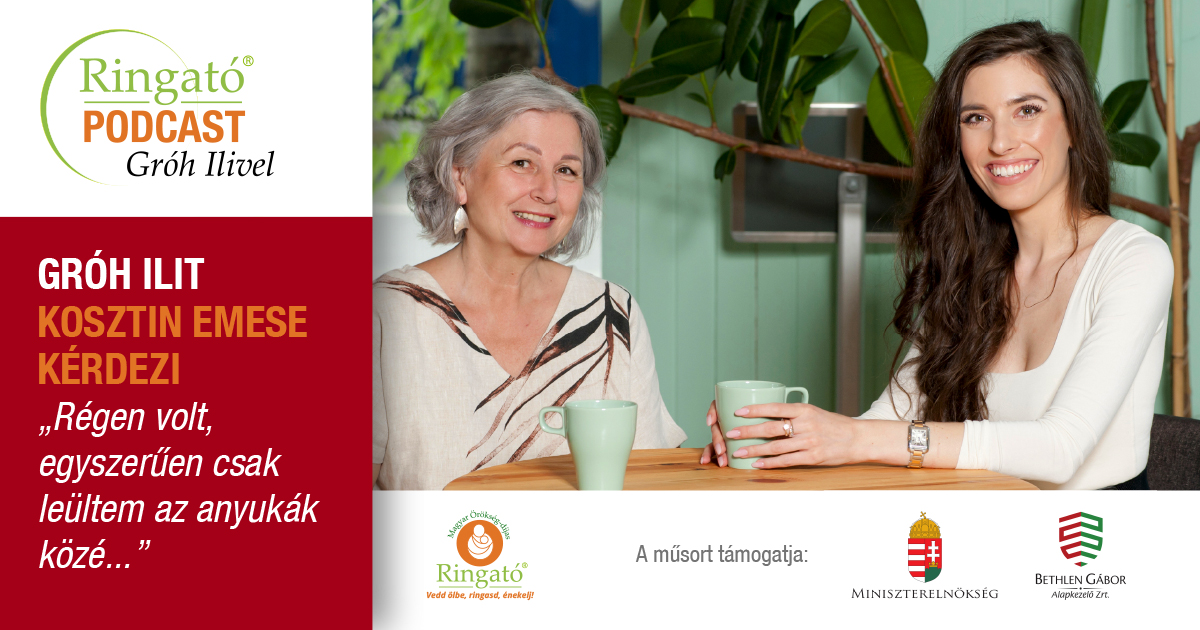
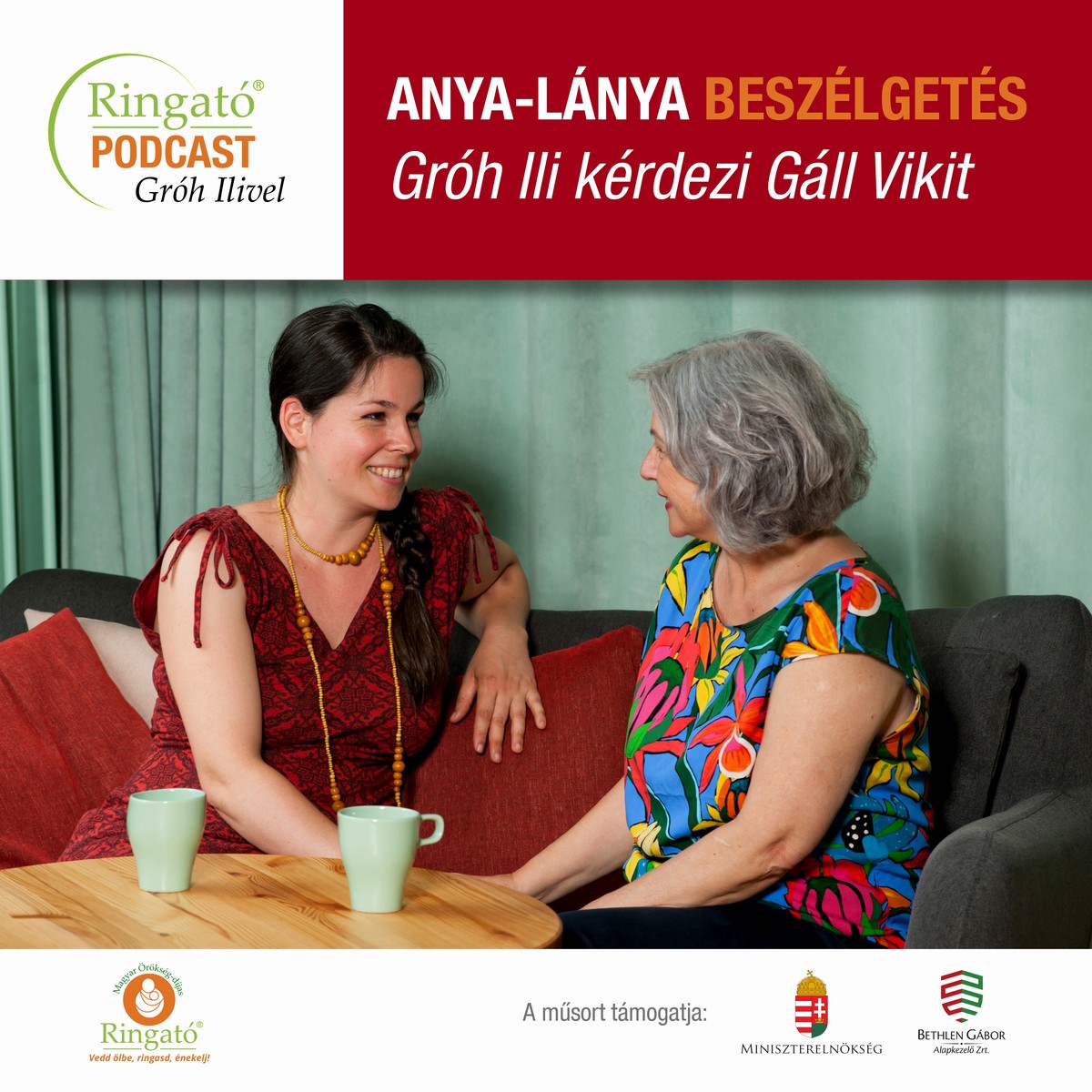
2. Ringató social-media communication in 2022 and production of the first Ringató Podcast episodes in 2023:
Thank you for the support!
5 November 2022
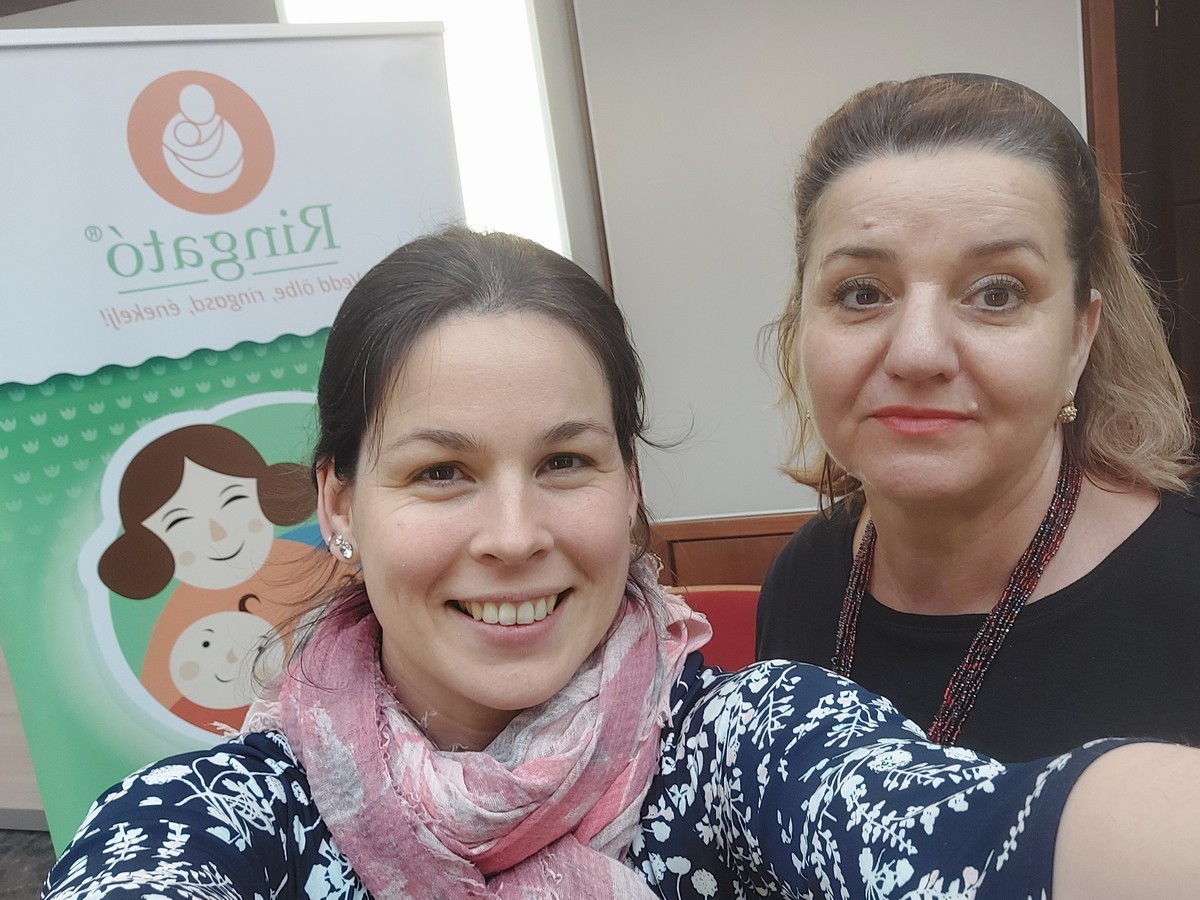
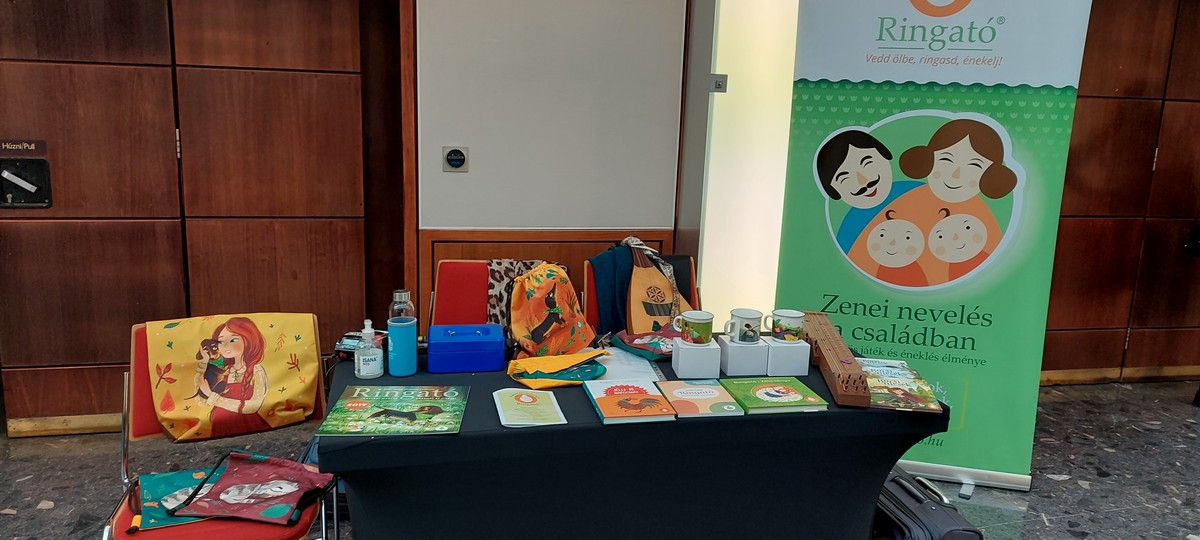
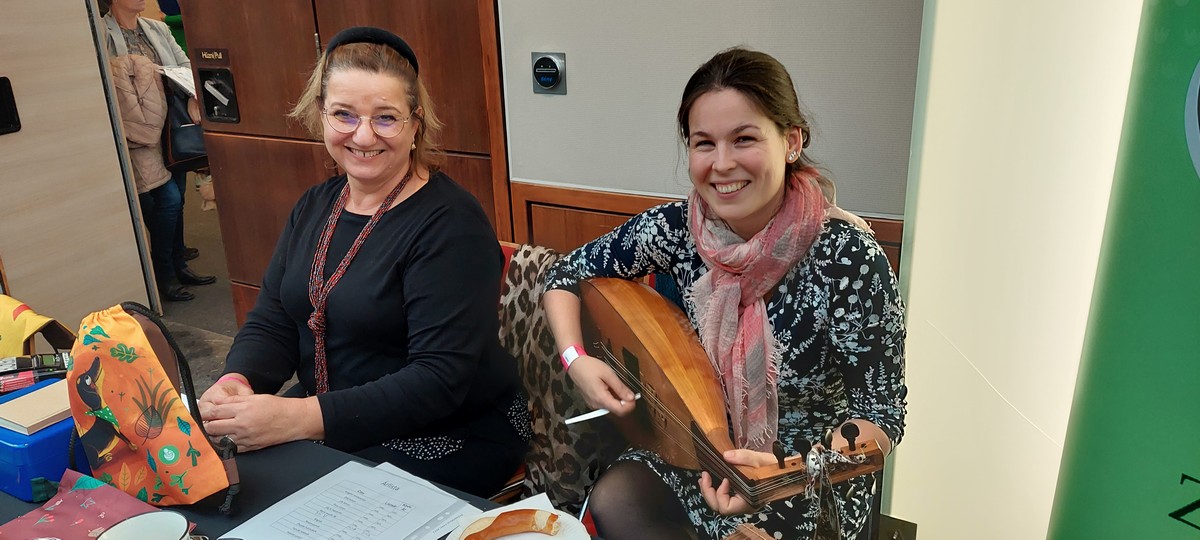
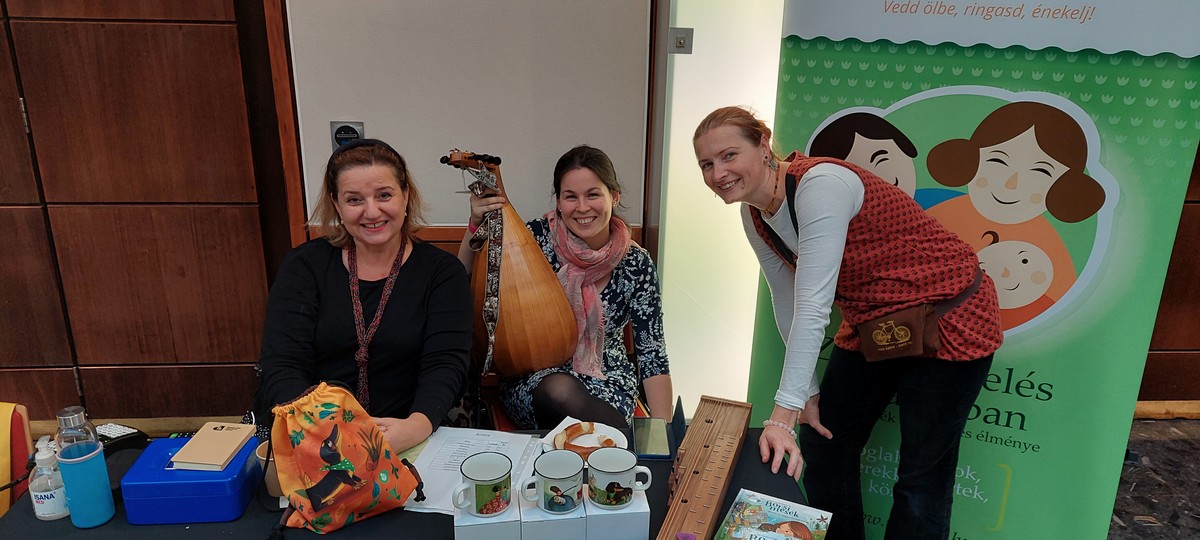
On 5 November 2022, the Ringató Hungarian Music Education Foundation participated as an exhibitor at the PedagógusExpoin order to introduce the Ringató methodology book published in 2022. We were able to meet many educators in person. Around 2,000 educators attend PedagógusExpo each year, including many early childhood educators and kindergarten teachers.
Applicants had to introduce themselves by video, on the basis of which it was decided whether they could participate in the training. The pre-selection ensured that those completing the course were suitable, both personally and professionally, to learn the special methodology of Ringató sessions and were capable of leading Ringató sessions. The previous year we had already held the training online, so the method was familiar and proven. The disadvantage of this format, however, was the absence of the experience of singing together. We genuinely missed this. In addition to the scheduled consultations, the programme leader regularly supports participants with written materials and methodology videos. They stay in touch by e-mail, Messenger and Facebook.
Nineteen people completed the course. Hungarian educators from diaspora communities in many parts of the world:
Virág Andrea - Australia
Balázs Csilla - United States
Temesi Krisztina - Ireland
Beyreiss Éva - Germany
Gregusné Becker Mária - Germany
Lokodi Emőke - Romania
Kiss Borbála - England
Domoszlai Orsolya - Australia
Hornai Anita - England
Gyorfi Rita Klaudia - England
Schenk Angyalka - Austria
Parti Margit - Canada
Dobai Kinga - Slovakia
Simon Andrea - England
Tempfli-Nagy Luca Zsófia - England
Deli-Fóris Mária - England
Kinnunen Veronika - Germany
Alzbeta Erzsi Vaculikova - Czech Republic
Brockhauserné Mató Katalin - Germany
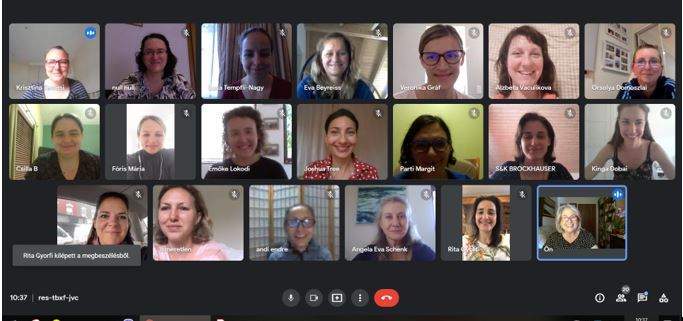
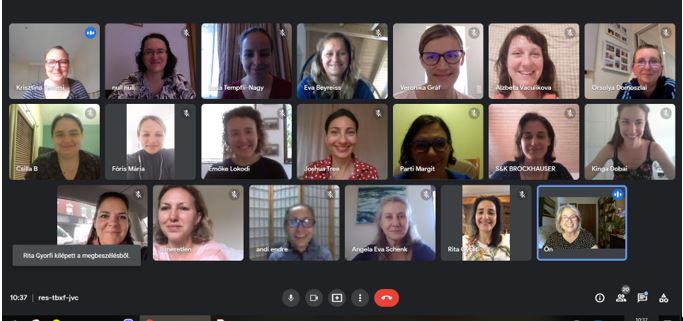
Because the training was held online using Google Meet, participants did not sign an attendance sheet. The screenshot shows the training participants and the instructor, Dr Ilona Gróh Gáll.
17 October 2021
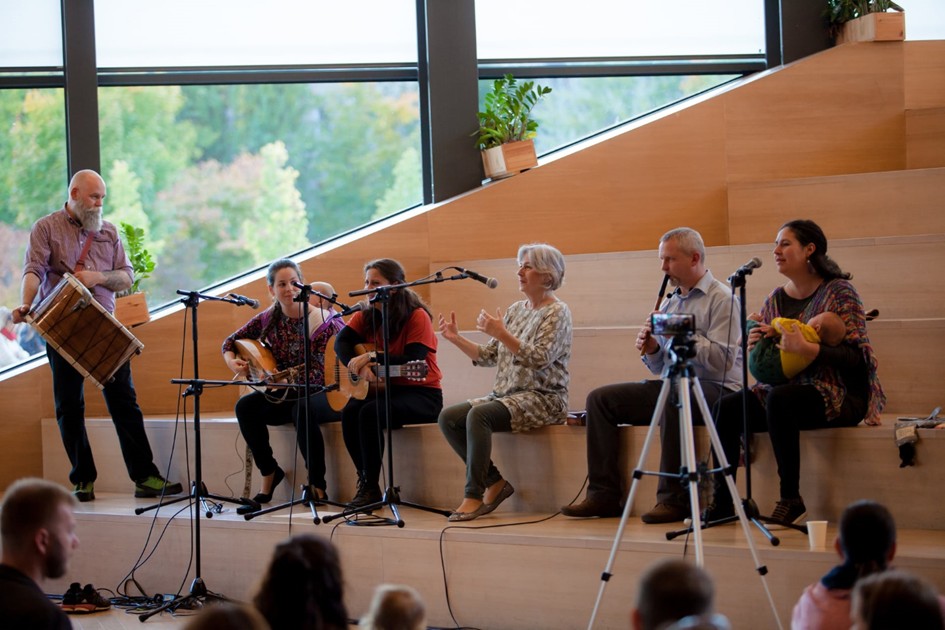
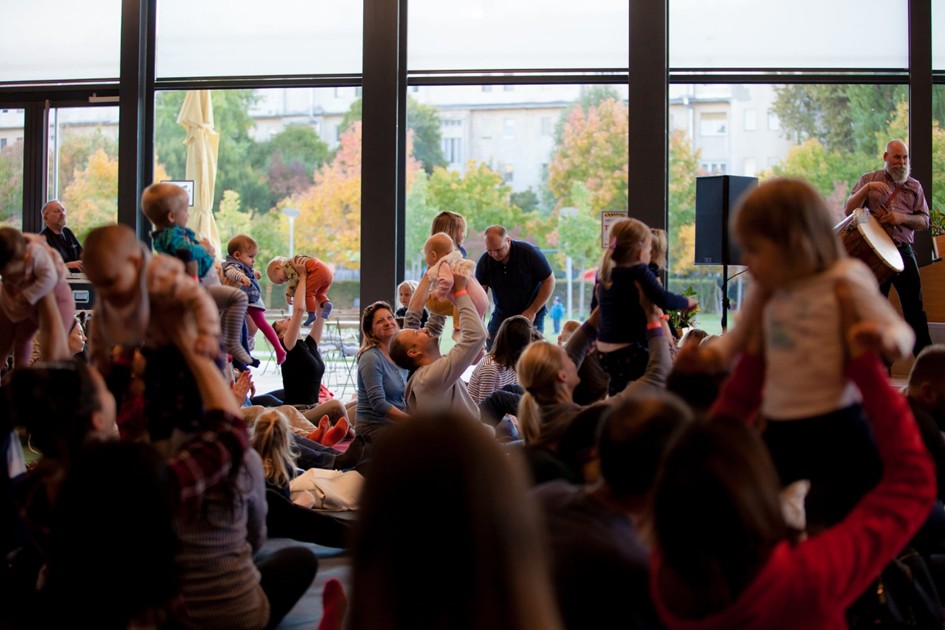
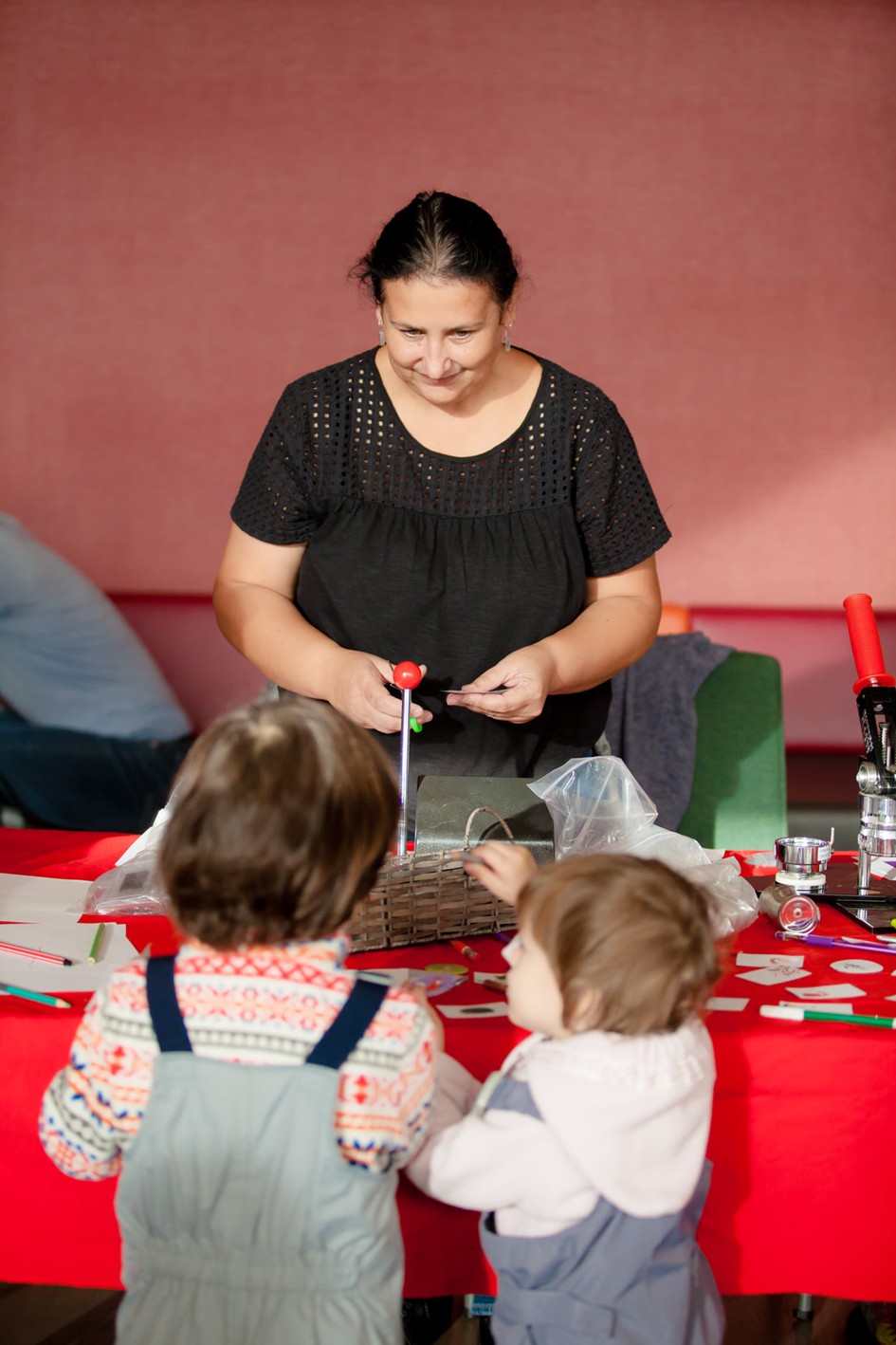
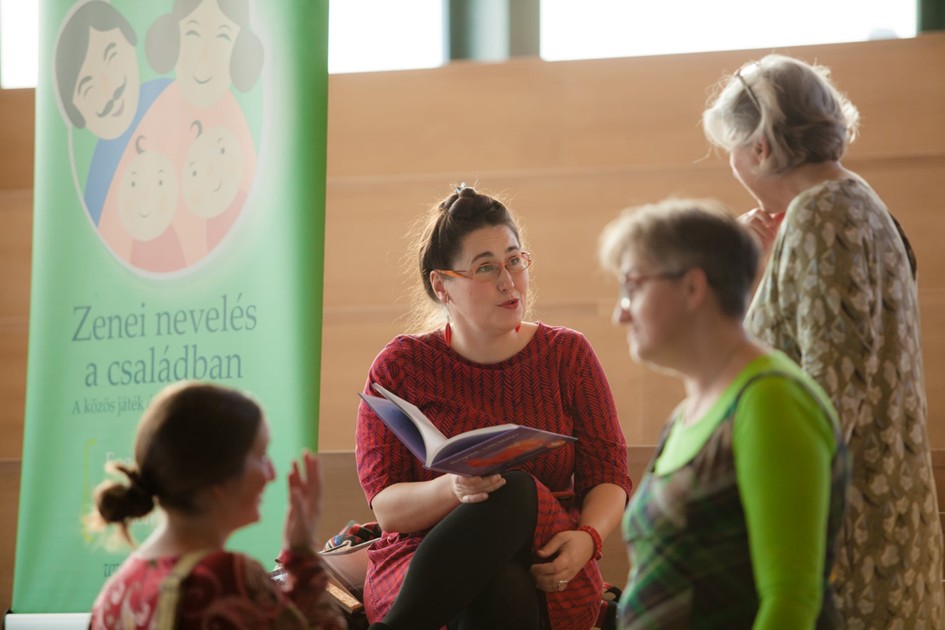
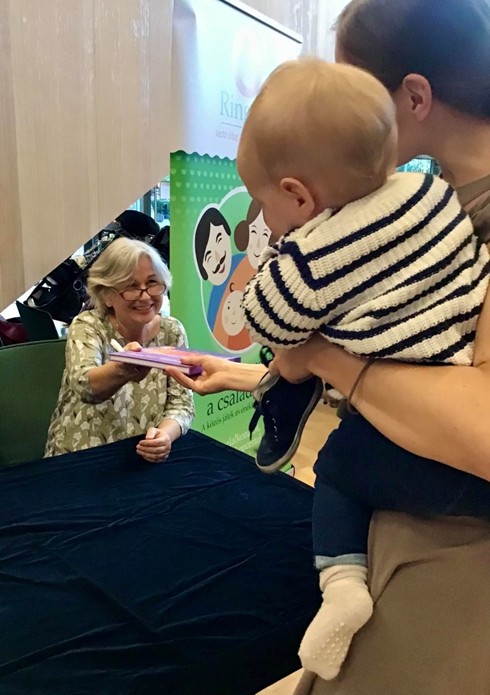
More than one hundred families honoured us with their presence at our event on 17 October 2021, where we presented the Ringató Purple Book with a children's concert, craft programme, discounted book sale and signing. The festive occasion was hosted by the National Dance Theatre. Our guest artist, Anna T. Szabó, also sang with us.
Support for the implementation of an online music-education course for Hungarian teachers living outside Hungary
3-7 August 2020
Our aim is for Ringató groups to be established in as many settlements of the Carpathian Basin as possible, providing families with young children with valuable content and experiences rooted in Hungarian traditions. Among the main strengths of Ringató sessions are their contribution to preserving the Hungarian language, developing and strengthening Hungarian identity, and building cohesive communities. With these goals in mind, and with the support of the State Secretariat for National Policy, we organised the Ringató methodology course for Hungarian educators living outside Hungary for the fourth time. Exceptionally, this year the teaching took place online at https://meet.google.com/. Applicants had the necessary technical facilities.
Applicants had to introduce themselves by video, on the basis of which it was decided whether they could participate in the training. The pre-selection ensured that those completing the course were suitable, both personally and professionally, to learn the special methodology of Ringató sessions and were capable of leading Ringató sessions. Despite the new and unusual online format, everything ran smoothly. We made use of the advantages offered by online training. After classes I sent students many links and materials to watch, which we could discuss the following day. There were compulsory professional materials and also a wide selection of optional videos. A disadvantage of this format is the absence of the experience of singing together. We genuinely missed this, and I have been thinking about how we might make up for it in the future. During a week of in-person training, participants also formed a small friendly community from outside Hungary, as singing and music-making often continued into the evening after classes. In the past, leisure programmes were a memorable part of the experience, which we could not reproduce in online training. We tried to compensate for this using the opportunities of the virtual space and social media. Follow-up support took place online in smaller groups and through individual consultations, organised via Messenger on five occasions by the end of December 2020. Contact continues online. In addition to the organised consultations, the programme leader regularly supports participants with written materials and methodology videos. They stay in touch by e-mail, Messenger and Facebook.
By the end of the course, 12 of the 17 participants living outside Hungary had started organising programmes in their local communities, although the pandemic unfortunately interrupted this work. I hope that as soon as circumstances allow, they will continue Ringató sessions, because I saw them begin after the course with great enthusiasm, determination and affection. Every participant received a Ringató book package, which we used regularly during the training. The 17 supported participants were all Hungarian educators living outside Hungary:
Antal Diána, Transcarpathia
Blága Anikó (Erdei Anikó), Transylvania
Borsodi Patyerek Orsolya, Vojvodina
Czellecz Ildikó, Germany
Drávai Gyurcsik Renáta, Vojvodina
Gyurkovics Katalin, Upper Hungary
Herczog Gabriela, Upper Hungary
Horváth Boglárka, Upper Hungary
Kemény Mária, Vojvodina
Kiss Krisztina, Vojvodina
Kovács-Molnár Lili, Germany
Lakatos Andrea, Transylvania
Lukács Sára, Vojvodina
Mitru Barbara, Transcarpathia
Nagy Mariann, England
Szuhay Mária, Upper Hungary
Timaru Carina (Tímár Karina), Moldavia
Closed group for participants: https://www.facebook.com/groups/1663353980495888
Ringató methodology course for Hungarian educators living outside Hungary, with the support of BGA Zrt.
Budapest, 1-15 July 2019
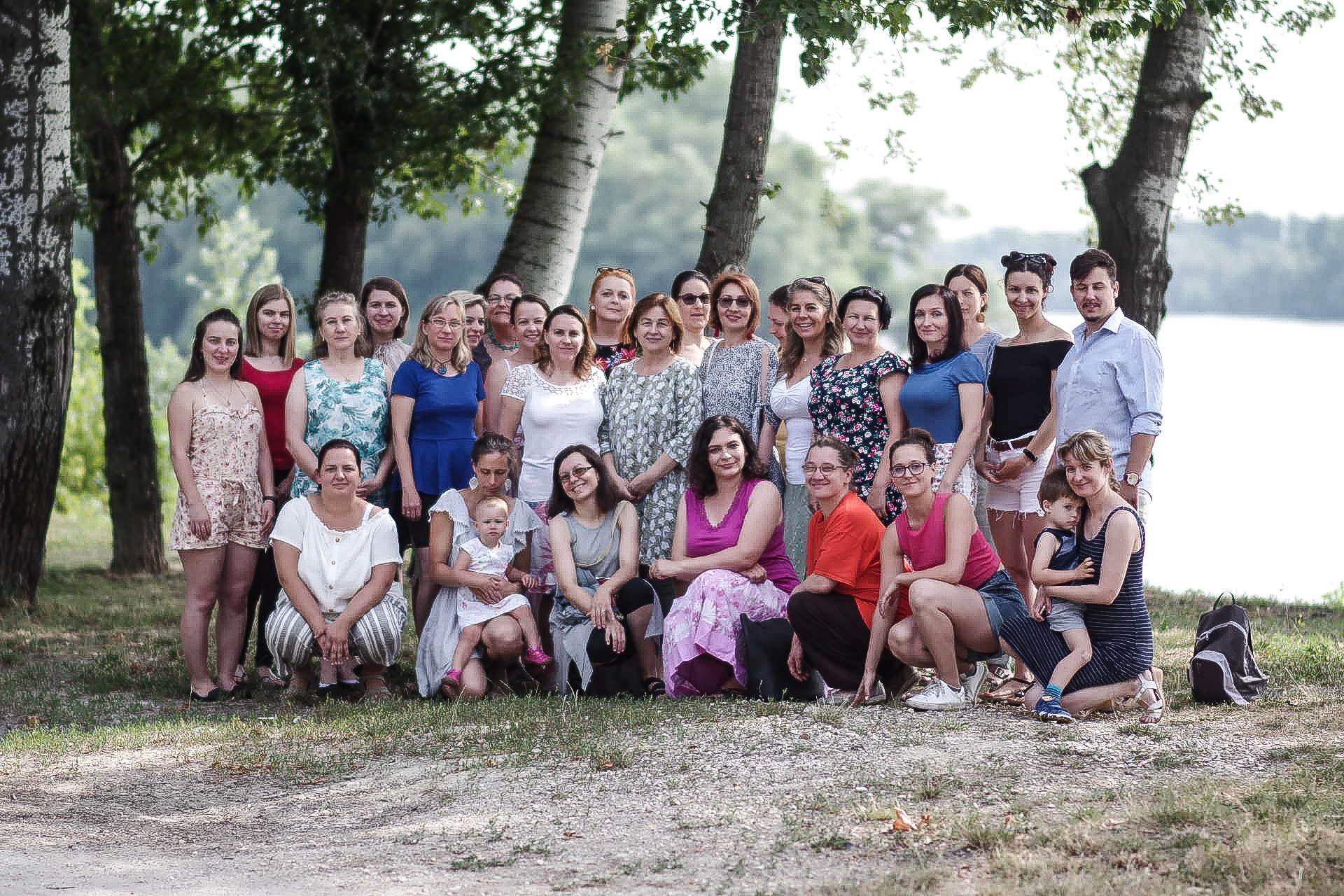
The aim of the training is to establish Ringató groups in as many settlements outside Hungary as possible so that families with young children receive valuable content, genuine values and experiences rooted in Hungarian traditions, and so that the community-building effects of singing and playing together can be realised in the sessions.
The plan included pre-selection, training and follow-up support and it was implemented in accordance with the plan.
The pre-selection was carried out online; applicants had to send an introductory video based on specified criteria. After selection, the course began with the following participants:
| Name | City | Region |
| Alt Kapczy Ildikó | Zseliz | Upper Hungary |
| Barabás Mónika | Temesvár | Transylvania |
| Bereczki Klára | Temesvár | Transylvania |
| Iffiú Réka (Demeter) | Sepsiszentgyörgy | Transylvania |
| Dobai Eszter | Dunamocs | Upper Hungary |
| Erőss Judit | Sepsiszentgyörgy | Transylvania |
| Farkas Rebeka | Kiskeszi | Upper Hungary |
| Fekete Krisztián | Szolyva | Transcarpathia |
| Ferenczi Júlia | Sepsiszentgyörgy | Transylvania |
| György Tünde | Cluj-Napoca | Transylvania |
| Hanák Rigó Ildikó | Piros | Vojvodina |
| Hantos Judit | Bologna | Italy |
| Hardi Klemm Katalin | Vojvodina | |
| Havasi Orsolya | Visk | Transcarpathia |
| Kecskés Márta | Diósförgepatony | Upper Hungary |
| Kertész Prim Adrienn | England | |
| László Delinke | Bálványosváralja | Transylvania |
| Parti Margit | Edmonton | Canada |
| Révész Csilla | Zselíz | Upper Hungary |
| Rontó Márta | Vojvodina | |
| Schenk Angyalka | Insbruck | Austria |
| Szabó Tünde | Sepsiszentgyörgy | Transylvania |
| Szilágyiné Tóth Gabriella | Beregszász | Transcarpathia |
| Takács Zsuzsanna | Nagybecskerek | Vojvodina |
| Vacík Jenes Alíz | Prága | Czechia |
| Zacharov Erika | Somorja | Upper Hungary |
| Pataki Anna | Brünn | Czechia |
As professional materials, the students received all Ringató publications, a collection of quotations from the writings of Zoltán Kodály, and an extensive bibliography.
Training lectures were held Monday to Friday, from 9:00 to 16:30 each day.
The course followed the previously announced curriculum. Each theoretical section was supplemented by carefully designed, thorough practical training, including learning games and songs, methodological exercises, two live demonstration sessions and session analysis. Individual consultations were also available during breaks. This was complemented by two two-hour training blocks on marketing and social media.
Throughout the course I found that the students participated with exceptional interest; they were open, willing and cooperative in every respect.
The participating educators had an appropriate level of musical and music-pedagogical preparation, and several had outstanding musical and methodological qualifications and knowledge.
Ringató methodology course for Hungarian educators living outside Hungary, with the support of BGA Zrt.
Budapest, 18-23 June 2018
The aim of the training is to establish Ringató groups in as many settlements outside Hungary as possible so that families with young children receive valuable content, genuine values and experiences rooted in Hungarian traditions, and so that the community-building effects of singing and playing together can be realised in the sessions.
The plan included pre-selection, training and follow-up support and it was implemented in accordance with the plan.
The pre-selection The pre-selection took place online; applicants had to submit an introductory video based on specified criteria. After selection, the course began with 22 participants. Twenty came from Upper Hungary, Transylvania and Vojvodina, one from Austria and one from Macedonia.
List of participants:
Barabás Mónika, Transylvania
Benedek Tibor Magor, Transylvania
Bereczki Elekes Klára, Transylvania
Dognár Mónika, Vojvodina
Gordos Szilvia, Vojvodina
Gúti Annamária, Vojvodina
Hanák Rigó Ildikó, Vojvodina
Jakab Krisztina, Upper Hungary
Kecskés Márta, Upper Hungary
Kosztyó Bodnár Györgyi, Upper Hungary
Magyari Csilla, Transylvania
Patala Annamária, Vojvodina
Pop Aleksova Elena, Macedonia
Rácz Nagy Tünde, Vojvodina
Schenk Angyalka, Austria
Szabó Rapcsák Lotti, Vojvodina
Szabó Róbert, Vojvodina
Szécsi Viktória, Vojvodina
Takács Zsuzsanna, Vojvodina
Torok Orsolya, Upper Hungary
Varga Hajnalka, Upper Hungary
Zacharov Erika, Upper Hungary
As professional materials, the students received all Ringató publications, a collection of quotations from the writings of Zoltán Kodály, and an extensive bibliography.
Training lectures were held Monday to Friday, from 9:00 to 16:30 each day. The course followed the previously announced curriculum. Each theoretical section was supplemented by carefully designed, thorough practical training, including learning games and songs, methodological exercises, two live demonstration sessions and session analysis. Individual consultations were also available during breaks. This was complemented by two two-hour training blocks on marketing and social media.
Throughout the course I found that the students participated with exceptional interest; they were open, willing and cooperative in every respect.
The participating educators had an appropriate level of musical and music-pedagogical preparation, and several had outstanding musical and methodological qualifications and knowledge.
Follow-up support
After completing the course, every participant was given the opportunity to join the Ringató music education programme and the Ringató network. Of the 22 participants, we currently have Ringató trademark-use agreements with eight, so they work as Ringató session leaders in and around their home towns. The agreements were concluded last year after the course ended, and at the same time all of them received substantial promotional material and written support. Several requested verbal consultations via Skype, asked for advice and reported successes. They attended our professional days in autumn 2018 and spring 2019; we also remain in contact on Facebook, and I continuously follow their professional activity.
I receive extremely positive feedback from them; they hold regular sessions. They often report their successes and also stay in touch with one another.
Beneficiary: Ringató Hungarian Music Education Foundation
Project title: "Ringató with the grandchildren programme - grandparents and young children"
Contracted grant amount: 25.000.000,- Ft
Grant intensity: 100%
Description of the project period: The aim of the EFOP-1.3.5-16 call entitled "Strengthening social participation through community development" is to facilitate the creation and development of new small communities so that local needs can emerge, and to strengthen existing communities.
This scheme primarily promotes territorial and social cohesion by activating young people, families, physically and mentally active older people and pensioners socially and economically within small-community settings, strengthening their participation in public life, supporting charitable and voluntary activities, and fostering cooperation between generations.
By implementing project EFOP-1.3.5-16-2016-00996 entitled "Ringató with the grandchildren programme - grandparents and young children", we contribute to strengthening cooperation and relationships between generations and social cohesion; encouraging participation in voluntary and charitable activities; strengthening community integration and civil society; and achieving the goal of social solidarity.
Planned project completion date: 2020.07.01.
Project identification number: EFOP-1.3.5-16-2016-00996
Thanks to the successful grant application of the "Én Ovim" Foundation, from 1 January 2017 to 31 December 2018 the Foundation, together with the Ringató Baráti Társaság Association, implemented a colourful programme aimed at reaching families with young children in a variety of ways. The programme included group sessions, events and workshops in Southern Transdanubia.
Photos from the joint events are available here!
Further information about the "Én Ovim" Foundation is available here.
Final professional report for project EFOP-1.2.1-15-2016-00111
For the period from 1 January 2017 to 1 January 2019
Our application entitled Ringató - Complex Family Support Programme in Southern Transdanubia, submitted under the call "Safety net for families", was awarded support on 12 December 2016. The grant amounted to HUF 39,999,952, which we used to implement a programme series spanning two years.
The project management team worked continuously on requests for quotations, contracting, organising and implementing professional programmes, as well as preparing payment claims, professional reports and supplementary submissions.
The programmes were carried out according to the original plan thanks to the enthusiastic, high-quality work of the participating implementers.
The events were highly successful and attracted enormous interest.
The overall objective of the project was to strengthen the social role of the family and increase family cohesion by providing complex services.
The project's specific objectives assigned to the target groups were:
Increase the number of parents and prospective parents with up-to-date knowledge of child-rearing.
Support families in special or difficult life situations and improve their circumstances through assistance services supplementing the activities of municipal family-support institutions.
Disseminate proven model programmes and good practices more widely, strengthen communities in which families support one another, and encourage local cooperation for the well-being of families.
The programmes were implemented in 16 settlements in Southern Transdanubia, with particular emphasis on the Szekszárd and Pécs subregions.
The programmes implemented with our institutional and professional partners also carry the promise of future cooperation.
Long-term objective: we consider it important that the project's impact should spread widely and, in addition to local benefits, be meaningful and sustainable beyond the region. Our project used the many-sided expressions of human existence - musical, movement-based, creative, experiential, communicative and interactive - to build a complex family-support model.
The success of the project is demonstrated by the fact that, compared with the planned minimum of 400 participants by 1 January 2019, 1,533 people took part in our programmes.
The counselling sessions took place according to the Gantt chart, and by the end of the project we had met the target value. A total of 192 people participated in counselling.
The small-group sessions for 10 participants took place according to the Gantt chart, and by the end of the project we had met the target value. A total of 240 people participated in the sessions.
The group sessions for 20 participants also took place according to the Gantt chart, and by the end of the project we had met the target value. A total of 361 people participated in the sessions.
Workshops were held every six months. A total of 192 people participated in these events.
The planned programmes in the project were delivered according to the Gantt chart, and the number of participants in every case reached or exceeded the original plan.
Participant numbers were calculated using a function from a table prepared from attendance sheets, thereby excluding duplication.
We would like to thank you for supporting our programme and making its implementation possible!